
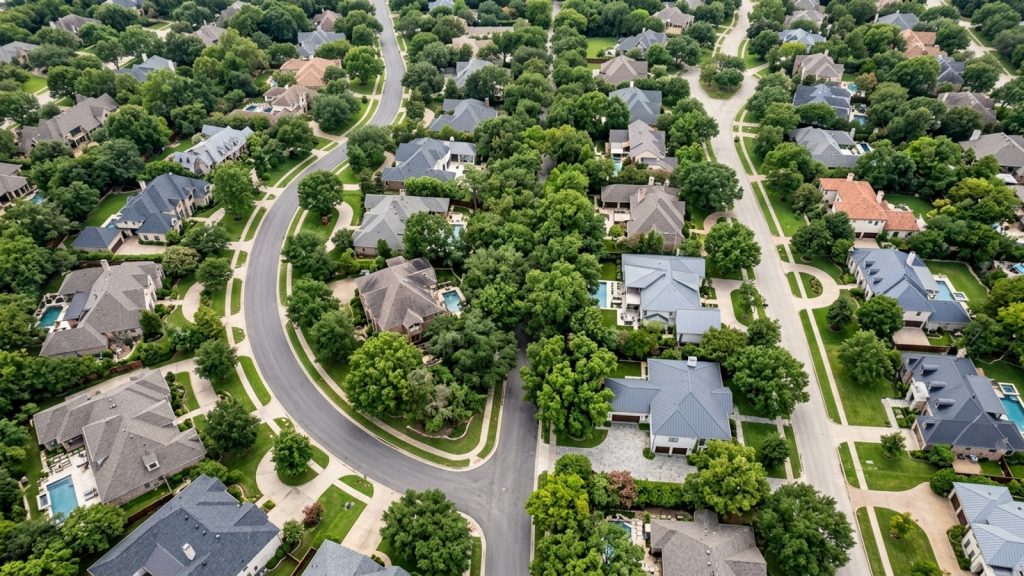
The median sale price in Preston Hollow sits around $2.41 million as of mid-2026. At that price point, buyers don’t show up uninformed – they’re backed by thorough appraisals and they’ve done their homework. When selling a home in Preston Hollow, your asking price has to hold up to that scrutiny from day one.
What you put on that sign matters more than most sellers expect. It controls how many buyers walk through the door and how long the house sits before one of them makes an offer. With roughly 130 homes available in the neighborhood right now, understanding how local data shapes buyer expectations isn’t optional – it’s the work you do before you list.
Current Real Estate Market Conditions in Preston Hollow
Preston Hollow is carrying about 4.5 months of housing supply, which puts it in relatively balanced territory with a slight tilt toward sellers. During the summer of 2026, 89 homes closed in the neighborhood – a meaningful data set for what buyers are actually willing to pay.
One number worth sitting with: properties here are closing at an average of 96.55% of list price. That gap is your reality check. Most buyers are negotiating a modest discount off the ask, and if you don’t build that expectation into your opening number, you’re already behind.
Assessing Inventory and Leverage in Dallas County
Pull back to Dallas County and the picture shifts a little. Homes countywide are selling after an average of 41 days on the market, with a median sale-to-list ratio of 97.36% – slightly tighter margins than you’ll see in the luxury-heavy Preston Hollow market specifically.
The inventory level is what determines who has leverage at the table. When supply climbs, buyers feel comfortable asking for repairs or closing cost credits. When months of supply drops below three, you start seeing multiple offers and fewer financing contingencies. Knowing where you sit in that range tells you how much flexibility you actually have.
What Days on Market Means for Your Listing
The median days on market for Preston Hollow right now is 44 days. Earlier in 2026, that figure was running between 52 and 63 days – normal seasonal movement for Texas real estate.
Once your home drifts meaningfully past that 44-day mark, something shifts in how buyers read it. They watch the MLS closely, and a stale listing reads as a signal that the seller will take less. Whether that’s true or not, you’re negotiating from a weaker position the moment that assumption takes hold.
Using a Comparative Market Analysis to Find Fair Market Value
About 10.4% of homes in Preston Hollow have sold above asking price recently. That’s not the majority – but it’s not nothing either, and it tells you the market rewards accurate pricing. Finding fair market value starts with a Comparative Market Analysis, a detailed report that evaluates similar properties that have recently changed hands.
A good CMA looks at active listings to gauge what you’re competing against and expired listings to see which price points buyers flat-out rejected. That combination is what helps you land on a number that holds up when a buyer’s lender sends an appraiser through the door.
Selecting the Right Neighborhood Comps
Comps in Preston Hollow only work if they’re genuinely comparable. Square footage, lot size, and architectural style all matter. A mid-century ranch needs to be measured against other updated ranches – not a new-construction modern estate that sold last month.
Location within the neighborhood moves the needle too. A home on a quiet interior street and one backing up to Northwest Highway or Preston Road aren’t interchangeable, regardless of what the square footage says.
The Limits of Automated Valuation Models
National portals generate instant estimates through Automated Valuation Models – algorithms pulling from public tax records. They can’t see custom finishes, recent luxury upgrades, or a layout that happens to be awkward. They average out entire zip codes.
For a $2.41 million property, that’s a real problem. An AVM can just as easily push you to leave money on the table as it can hand you an unsupportable number that keeps buyers from scheduling a showing. Neither outcome is where you want to start.
Proven Approaches to Pricing Your Property
With median sale prices exceeding $2.4 million, where you set your number affects more than just negotiations – it affects who even finds your listing. A property priced at $1.99 million shows up in searches capped at $2 million. One priced at $2.05 million doesn’t. That’s search bracket optimization, and at this price tier it’s not a small distinction.
Your strategy should reflect your actual timeline and financial goals. There’s a real tension between selling on a tight schedule and maximizing the closing price, and the right approach sits somewhere in that space.
Listing at Exact Market Value
Pricing at the property’s precise appraised value is straightforward and works especially well for buyers using traditional financing. It reduces the risk of an appraisal gap – the situation where the bank won’t lend the full purchase amount because the home didn’t appraise high enough to support the price.
Homes priced at market value tend to draw serious, qualified buyers. Showings stay steady, and the path through underwriting is generally cleaner.
Pricing Below Market to Build Momentum
Listing slightly below fair market value is designed to create immediate interest and bring more buyers through the door at once – the goal being competing offers that push the final price up on their own.
It’s worth being honest with yourself about this one: it only works if you’re genuinely comfortable with the possibility that you get one offer at the lower number and that’s it. This strategy performs best when inventory is thin and buyer demand is concentrated. In a market with 4.5 months of supply, those conditions aren’t guaranteed.
The Risks of Setting the Price Too High
Overpricing to leave room for negotiation sounds reasonable in theory. In practice, buyers searching within a specific budget never see the listing, and the ones who do tour it are comparing it to properly priced homes with better amenities.
Days accumulate. A price drop eventually follows. By the time the number aligns with what the market was telling you from the start, the early surge of buyer attention is long gone – and the listing carries the stigma of having sat.
Adjusting the Asking Price After Listing
When a Preston Hollow home hits 44 days without an offer, it’s reached the neighborhood median. That’s the moment to stop waiting and start evaluating the price, the showing activity, agent feedback, and whether the issue is the number, the presentation, or something about the property itself.
Price adjustments are a normal part of the process when early assumptions don’t match what buyers are actually doing. The sellers who struggle are the ones who wait too long to acknowledge the disconnect.
Timing a Price Reduction
Two to three weeks of steady showings with no offers is a reasonable trigger to revisit your strategy. No showing requests at all is a more urgent signal – it usually means the price is out of step with the broader Dallas County market, not just the immediate competition.
When you do cut, make it meaningful. A series of small reductions drags out the process and signals hesitation. One significant adjustment tells buyers the seller is motivated and, practically speaking, moves the listing into a new set of online search brackets where a fresh audience will see it for the first time.
Frequently Asked Questions
How do you price a teardown lot versus a move-in ready home in Preston Hollow?
It depends on the land value. Teardown lots are priced based on the acreage and location within Preston Hollow. Move-in ready homes factor in the structure’s condition and recent upgrades.
Is it better to underprice a Dallas luxury home to spark a bidding war or list at exact market value?
It depends on current inventory. With Preston Hollow holding 4.5 months of supply, listing at exact market value is generally safer. Bidding wars are less guaranteed than in a low-inventory market.
What happens to the final sale price if I overprice my Preston Hollow house right out of the gate?
The final sale price often drops below market value. Overpriced homes sit on the market past the 44-day median and become stale. They typically require significant price reductions to attract buyers.
How long should my Preston Hollow estate sit on the market before I consider a price reduction?
You should consider a reduction after two to three weeks of showings without an offer. If your home approaches the neighborhood median of 44 days on market, it’s time to adjust the asking price.
Do off-market pocket listings in Dallas affect how I should price my Preston Hollow property?
Yes, they can influence pricing. Off-market sales don’t immediately appear on the Multiple Listing Service. They still represent active competition and closed sales that appraisers use to determine local values.
How much actual value do custom luxury upgrades add to an asking price in Preston Hollow?
It depends on the specific upgrade and buyer preferences. Automated valuation models often miss these details entirely. You should rely on a Comparative Market Analysis to measure how recent luxury finishes impact the $2.41 million median sale price.