
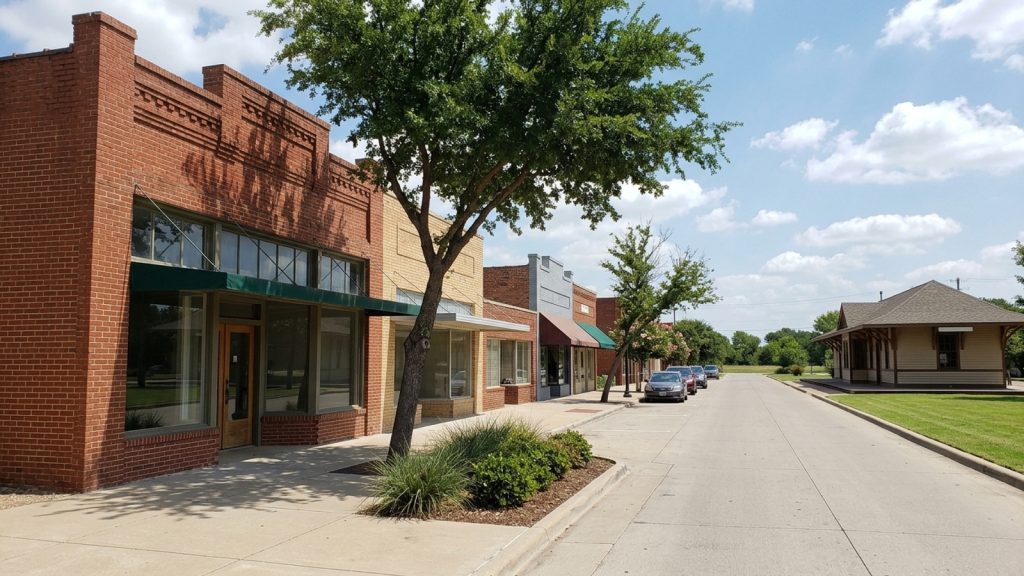
Allen, TX sits about 20 miles north of downtown Dallas – a major northern suburb in the Dallas-Fort Worth metroplex that started life as a railway stop and kept building from there. What you see today, a significant residential hub in Collin County, grew out of a single decision to run a rail line through open prairie in the 1870s, shaping many of the pros and cons of living in Allen, TX.
If you’re looking at homes here, you’re looking at a market where the median sale price runs roughly $527,000. Knowing how this town came together – where the original infrastructure landed, how the streets got laid out – gives you a real feel for why the older neighborhoods are shaped the way they are.
Early Settlement and the Founding of Allen
Allen was established in 1870 by a purchasing agent for the Houston and Texas Central Railway. Before the trains came through, there was scattered pioneer activity, but nothing that added up to a town. The railroad changed that almost immediately, fixing the commercial center in place and dictating how the earliest roads would run.
It’s one of those cases where the infrastructure came first and the community filled in around it.
How the Town Got Its Name
The town was officially named in 1872 for Ebenezer Allen – a former attorney general of Texas and a prominent promoter of the Houston and Texas Central Railway. The railway company named the stop after him, and the name has never changed, even as that small stop grew into what you see today.
Historic Landmarks and Local Museums
The Allen Old Stone Dam was built in 1874 and originally served as a steam locomotive watering station for the Houston and Texas Central Railroad. It’s now both a State Archeological Landmark and listed on the National Register of Historic Places – which tells you something about how seriously the town takes that early infrastructure. If you spend any time in the older sections of Allen, you start to see how directly those original rail lines shaped where things got built.
The Allen Heritage Center
The Allen Heritage Center – also called the Allen Depot – operates out of a replica of the original railroad depot and is maintained by the Allen Heritage Guild. It functions as a history museum, with exhibits on the pioneering Allen families and the local railroad expansion.
The displays also cover Ebenezer Allen himself, the outlaw Sam Bass, and the Interurban railway system. It’s a straightforward look at what daily life looked like during the town’s earliest decades, without a lot of embellishment.
Location and Real Estate Growth
Allen sits entirely within Collin County, Texas. Its position as a northern DFW suburb means direct access to the major employment centers of Dallas, which has driven decades of residential expansion outward from the original historic core.
The market right now moves at a measured pace. Homes are selling in roughly 43 days, buyers are coming in close to list price, and available inventory sits at about 3.5 months – which is a balanced environment for anyone who needs a reasonable amount of time to make a decision. The town is still building, still blending that railroad-era foundation with newer suburban construction, so the development picture here isn’t static.
Frequently Asked Questions
What is Allen, TX known for?
Allen is known primarily as a major northern suburb of the Dallas-Fort Worth metroplex, with a history rooted in the Houston and Texas Central Railway. The 1874 Allen Old Stone Dam – originally a locomotive watering station – is the most recognized historic landmark.
What county is Allen, TX in?
Allen is in Collin County, about 20 miles north of downtown Dallas.
How did Allen get its name?
The town was named in 1872 after Ebenezer Allen, a former attorney general of Texas who also promoted the Houston and Texas Central Railway.
When was Allen, TX founded?
Allen was established in 1870 by a purchasing agent for the Houston and Texas Central Railway.
Are there historic districts with older homes in Allen, TX?
Yes. The oldest areas of the community are centered around Allen’s railroad origins – particularly around the Allen Heritage Center and the site of the 1874 Allen Old Stone Dam.
Are there any famous people from Allen?
The Allen Heritage Center’s exhibits reference the outlaw Sam Bass as a historical figure connected to the area. The museum also maintains records on the pioneering families who helped establish the town in the 1870s.
How does Allen compare to other local suburbs?
Buyers frequently evaluate multiple communities in Collin County before settling on a location. A direct comparison between Allen and Frisco shows that both areas offer direct access to major Dallas employment centers. Allen currently provides a balanced environment for buyers, with homes selling at a measured pace.