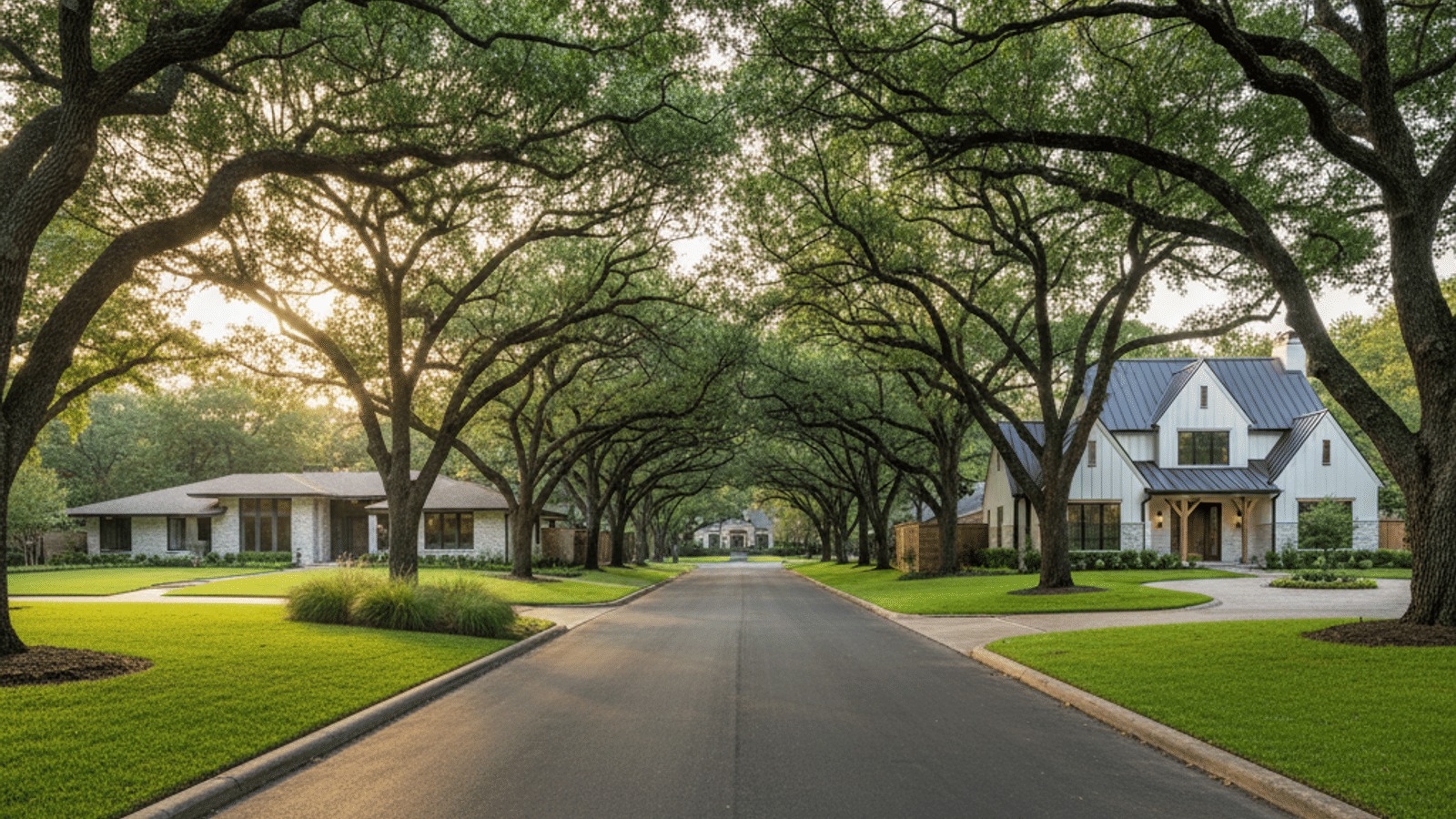
If you are looking for estate-style living within the Dallas city limits, Preston Hollow has likely been at the top of your list for a while. It is one of the few places in the metroplex where you can find acre-plus lots, mature tree canopies, and genuine privacy just minutes from downtown. As we settle into February 2026, the conversations I’m having with clients are notably different than they were a year or two ago.
The frenzied bidding wars have largely quieted down, replaced by a market that sends mixed signals depending on where exactly you look. We are seeing rising inventory levels across the board, yet prices in the top-tier luxury segments remain stubborn. While the broader Dallas markets are stabilizing, Preston Hollow remains a segment-specific beast. You can’t just look at “average” data here because a $10 million estate sale skews the numbers differently than a $900K lot-value transaction. For anyone thinking about living in Dallas, understanding these nuances is key to making a smart move this spring when buying a home in Dallas.
Preston Hollow Market Snapshot (February 2026)
To understand what is happening right now, we have to look beyond the headlines. If you were to pull a general report for the area, you might see median sales prices fluctuating wildly. That is because the data often lumps ultra-luxury mansions together with smaller 1950s ranch homes. In reality, some metrics show the luxury median hovering near $2.2M, while the broader mix—including the “cottage” inventory—sits closer to $890K. The takeaway here is that you need to filter your search by property type, not just zip code, and reviewing current market data helps both buyers and sellers stay informed.
Inventory is the biggest story of early 2026. Compared to the tight squeeze of early 2025, active listings are up significantly—some reports suggest nearly a 50% increase year-over-year. This influx of homes means buyers finally have options.
Consequently, the Days on Market (DOM) average has stretched out. We are seeing homes average 45 to 70 days on the market before going under contract. This is a breath of fresh air for buyers who are used to having 24 hours to make a decision. Now, you generally have time to view the home twice and run the numbers properly. The data suggests inventory supply is trending toward 4+ months, signaling a definite shift toward a balanced playing field.
A Tale of Two Markets: 75225 vs. 75230
Preston Hollow isn’t monolithic; it is really two (or more) distinct markets operating side-by-side. If you are looking at Dallas luxury homes, you are likely focused on the “Estate Section,” primarily located in the 75225 zip code. This is “Old Preston Hollow,” where the price floors are high, and the lots are massive. Here, median prices often exceed $1.9M, and it is not uncommon to see “tear-down” properties selling for land value alone because the dirt itself is so valuable.
On the periphery, largely in 75230, the dynamics change. This area offers more accessible price points, often ranging from $900K to $1.2M. The stock here includes smaller ranch-style homes and an increasing amount of new construction Dallas builders are putting up on subdivided lots.
Why does this matter to you? Because when you hear about a “median price drop” in the news, it often just means more smaller homes in 75230 sold that month, not that the value of the estates in 75225 has crashed. Recognizing this geographical split is crucial for setting realistic price expectations.
Buyer’s or Seller’s Market? Understanding the 2026 Dynamic
So, who has the upper hand right now? As of January 2026, the data points to a technically “Balanced Market,” though it is leaning slightly toward buyers in that $1M to $2M range. This is due to the absorption rate sitting at approximately 4.1 months of supply. In simple terms, if no new homes came on the market, it would take about four months to sell everything currently listed.
This shift has brought negotiation power back to the buyer’s side of the table. For the first time in years, list-to-sale price ratios have dipped below 100%—landing somewhere around 95% to 97% for many transactions. Buyers are finding they have room to negotiate not just on the price, but on inspection items and closing costs.
For sellers, this means strategy is everything. The days of “aspirational pricing” are over. Homes that are priced based on 2024 hype are sitting stagnant, accumulating days on market that hurt their final value, making it essential to position your home correctly to maximize your results.
Property Types & Architectural Trends
The physical inventory in Preston Hollow is in a state of transition. If you drive the streets, you will essentially see three main categories of homes.
First, you have the mid-century ranches. These are the original stock of the neighborhood. While some have been beautifully renovated, many are marketed primarily for their land value, destined to be replaced.
Second, there is a wave of new construction. The trend right now is heavily favored toward “Transitional” and Modern Farmhouse styles. These homes are replacing the older ranches, offering open floor plans and modern amenities that today’s buyers demand.
Finally, there are the luxury estates. These are the properties that put Preston Hollow on the map—gated homes on significant acreage (often 1+ acres) featuring guest houses, tennis courts, and extensive outdoor living spaces.
Preston Hollow vs. The Park Cities: A Comparative Look
Buyers often wrestle with the choice between Preston Hollow and the Park Cities (Highland Park and University Park). While both areas command high prices, the value proposition is different.
The biggest differentiator is lot size. In Preston Hollow, your money buys you land. You get setbacks, expansive lawns, and privacy. In contrast, Highland Park real estate is denser; you are paying for the location and the municipality, but you will likely be much closer to your neighbor.
The “vibe” is also distinct. Preston Hollow is quieter, darker at night (no streetlights in many parts), and less grid-like. The Park Cities area offers a more walkable, community-centric lifestyle where you might walk to dinner or the park.
From a financial perspective, the price per square foot in the Park Cities often exceeds $1,000. Preston Hollow generally offers value below that threshold, meaning you get more actual house and land for your investment.
Cost of Living Factors: Taxes and Fees
Beyond the purchase price, it is important to factor in the carrying costs of these properties. Since Preston Hollow is located within the city of Dallas, you are subject to Dallas County tax rates. Because valuations have risen over the last few years, property tax bills can be substantial, and it is smart to budget for this monthly.
Unlike some of the newer suburban developments, most of Preston Hollow does not have mandatory Homeowners Associations (HOAs). There are voluntary neighborhood associations that look after common areas and security patrols, but you typically won’t face the high monthly fees found in gated communities.
Insurance is another factor to watch. With the recent weather patterns in North Texas, premiums for high-value homes have risen. When calculating the cost of living in Dallas luxury neighborhoods, ensure you get an insurance quote early in the process, as coverage for older roofs or specific estate features can vary.
Lifestyle Drivers: Why Demand Persists
Despite the costs, demand for this area remains resilient. The primary driver for many residents is access to education. Preston Hollow is located along the “Private School Corridor,” placing it minutes away from top-tier institutions like St. Mark’s, Hockaday, Ursuline, and Jesuit. For households prioritizing education, this location is unbeatable.
Commute and logistics also play a huge role. The neighborhood flanks the Dallas North Tollway, offering a straight shot downtown or north to Plano and Frisco. You are also close to Love Field Airport for easy travel, and the luxury retail hubs of Preston Center and North Park Center are practically in your backyard.
2026 Forecast: What to Expect
Looking ahead to the rest of 2026, we expect price stability rather than sharp inclines or declines. Prices are likely to flatten, which is actually good news for the long-term health of the market. It offers stability for buyers and sellers alike, removing the fear of buying at the “top” or selling too low.
We are also keeping a close eye on inventory. If the supply continues to rise as it has in early 2026, buyers may see even better terms by mid-year. However, interest rates remain a variable. Minor rate fluctuations tend to impact the $1M–$3M buyer pool more than the ultra-luxury cash buyer, so the lower end of the Preston Hollow market may be more sensitive to banking changes in the coming months.
Your Advantage in Today’s Preston Hollow Market
Navigating the Preston Hollow market in 2026 requires more than just understanding price points. With varying property types, shifting inventory, and a more balanced dynamic, success comes down to strategy and execution. The Bale Real Estate Group helps buyers and sellers position themselves effectively through accurate pricing, targeted marketing, and clear guidance at every stage. The focus is on helping you make confident decisions while maximizing your results in one of Dallas’s most competitive luxury markets.
Frequently Asked Questions
Is Preston Hollow a buyer’s or seller’s market in 2026, ESPECIALLY WHEN BUYING A HOME IN DALLAS IN TODAY’S MARKET?
As of early 2026, it is technically a balanced market, though it leans toward the buyer in the $1M to $2M range due to rising inventory. Buyers currently have more leverage to negotiate inspection repairs and closing costs than they have had in recent years.
What is the average home price in Preston Hollow?
This varies significantly by location. The luxury “Estate” market (mostly 75225) often sees median prices around $2.2M, while the peripheral areas (75230) and smaller home segments average closer to $900K–$1.2M.
How does Preston Hollow real estate compare to Highland Park?
Preston Hollow offers significantly larger lots and more privacy for a lower price per square foot compared to Highland Park. Highland Park is denser, more walkable, and operates as its own municipality, which generally commands a higher price premium.
What zip codes are considered Preston Hollow?
The core of Preston Hollow falls primarily into 75225 and 75230. However, parts of the neighborhood and its immediate influence extend into 75244 and 75229, depending on how strictly you define the boundaries.