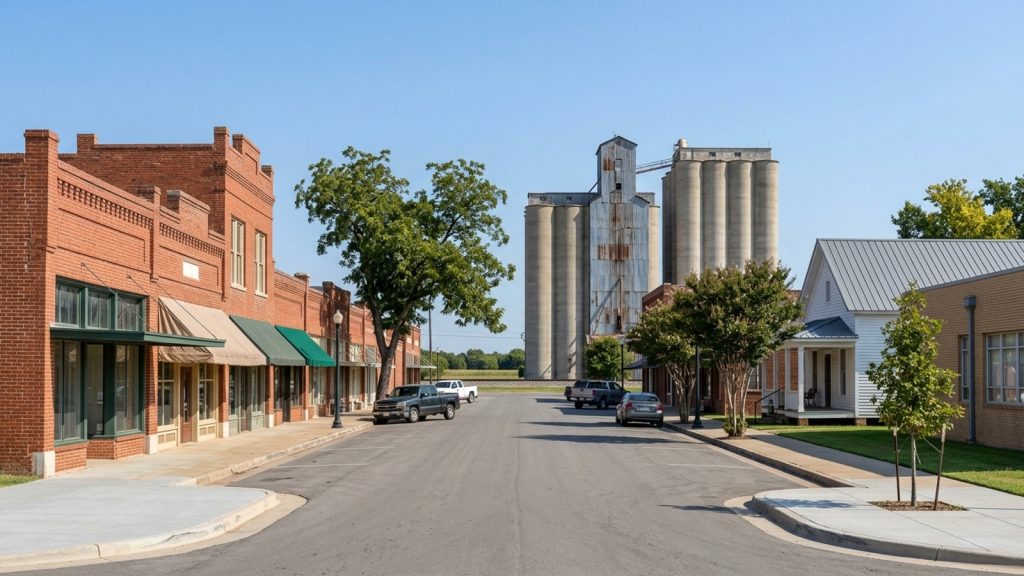
Prosper, TX stands out as a rapidly growing suburb in the Dallas-Fort Worth metropolitan area, drawing buyers with its master-planned communities and top-rated schools. Today’s real estate market reflects that demand, with a median home sale price around $872,000 and available homes spending roughly 84 days on the market. If you drive through the area, you’ll notice the mix of modern luxury builds and remaining agricultural spaces – that contrast isn’t accidental. It’s a pretty good summary of what this town is for buyers weighing the pros and cons of living in Prosper, TX.
Before it became an affluent DFW destination, this was a farming community built around a railroad stop. The town’s story involves merging settlements, a disputed post office name, and a slow transition from cotton fields to tech and finance employment. Understanding that history helps explain why Prosper looks and feels the way it does – and why buyers keep coming.
Geography and County Lines
Prosper sits within the Dallas-Fort Worth metropolitan area, placing it directly in the path of the region’s northward expansion. What complicates things slightly is that the town boundaries cross into two jurisdictions: Collin County and Denton County. If you’re buying here, you’ll want to confirm which county a specific property falls into, because that determines where your property taxes go and which county services you’ll receive.
It’s a more common situation than you’d think for expanding DFW suburbs, but it does mean practical things – vehicle registration, jury duty, county services – all depend on your exact address. Both Collin and Denton counties have absorbed enormous population influxes over the last two decades, and that regional pressure has driven the local economy and expanded the commercial infrastructure you see around town today.
A Town or a City?
Prosper was officially incorporated as a town on August 18, 1914, and it retains that classification today. It operates under a town government structure, and local leadership tends to hold onto that “town” identity deliberately – it’s not an oversight, it’s a choice. Given the explosive population growth of recent decades, that emphasis on small-town identity takes a bit of effort to maintain.
How Prosper Got Its Name
The original application for the local post office requested the name “Richland,” after one of the area’s early settlements. When community leaders submitted that paperwork, they learned the name Richland was already taken by another Texas post office. Postmaster B.J. Naugle had to go back to the community for a new suggestion.
J.C. Slaughter proposed “Prosper” because the local crops had produced well that year. There’s a competing version in the Texas Almanac that credits railroad officials with the name, suggesting they chose “Prosper” to reflect the prosperous living conditions the area offered its residents.
Both versions make sense, and neither fully contradicts the other. What’s clear is that the name fit – the Blackland Prairie soil was genuinely productive, and the post office was established under that name as the town grew around the railroad.
The Founding and Timeline
The earliest settlers arrived in 1846, drawn by fertile prairie soil to farm cotton. Between 1850 and 1902, two distinct communities existed here: Rock Hill and Richland. In 1876, 160-acre tracts were selling for $3.50 per acre, and Dr. A.T. Bryant of McKinney purchased what would eventually become the center of the modern town. Other early settlers during this period included M.C. Talkington and George T. Parvin.
The moment that shaped the town came in March 1902 with the arrival of the St. Louis, San Francisco and Texas Railway. The railroad bypassed both Rock Hill and Richland, which left residents of those two settlements with a simple choice: stay put or follow the tracks. They merged and relocated to the new railway stop, and that decision is the reason Prosper exists where it does today.
Growth Through the Decades
The town officially incorporated in 1914 with a population of 500. U.N. Clary served as mayor for 49 years – long enough to see the community through its entire early agricultural era. The population dipped to around 270 by the 1940s, as the Great Depression and World War II pushed residents toward industrial jobs or military service elsewhere.
Recovery started in 1980 with light industry moving into the area. That slow climb eventually turned into something much faster, and by 2023 the town’s population had reached an estimated 37,746. The transformation from a small farming stop to a major suburban center happened within living memory for some longtime residents – which is part of what makes the historic district worth paying attention to.
Historic Landmarks and Local Museums
The first brick home in Prosper was built in 1927 by longtime mayor U.N. Clary, and it’s still standing today as a recognized local landmark. The town maintains a Historic District featuring restored turn-of-the-century buildings, supported by the local Main Street program. Walk through it and you’ll find a courthouse, a jail, churches, shops, restaurants, and historic homes that somehow survived the construction boom around them.
The Downtown Advisory Committee and the Prosper Historical Society have marked specific sites through a Historical Markers project. Beyond the Clary home, recognized sites include the 1902 Prosper Flour Mill silo and the 1961 Prosper Post Office building – structures that connect the town’s agricultural and civic past to a present that looks very different.
The Local History Museum
The LTHS Museum is housed in a historic building and features exhibits on early settlers, local businesses, and notable events. The Prosper Historical Society also operates a local history museum and research center that preserves artifacts, photographs, and documents from the town’s earliest days through its modern expansion. If you’re the kind of buyer who wants to understand a place before you commit to it, both are worth an afternoon.
What Prosper Is Known For Today
For most of its early history, Prosper’s economy ran entirely on cotton, grain, and corn – it was a shipping center for farmers working the Blackland Prairie. That’s completely changed. Technology, finance, healthcare, and retail are the dominant sectors now, with major employers including the Prosper Independent School District, Kroger, and Chick-fil-A.
The town is recognized across DFW for its luxury master-planned communities and top-rated schools, and local leadership continues to push back against the sprawl mentality that can erase a place’s identity. That tension between growth and character is real here, and it’s one of the things buyers either respond to or don’t.
Famous Residents and Local Food
One local institution worth knowing about is “The Gin,” a restaurant whose name nods directly to the town’s agricultural past and whose breakfast menu has made it something of a community anchor. The broader dining scene has expanded to include Tex-Mex, barbecue, farm-to-table fare, Indian cuisine, and Japanese hibachi.
Prosper has also drawn a notable roster of residents from sports and entertainment: NFL Hall of Famer Deion Sanders, MLB outfielder Torii Hunter, NFL quarterback Davis Webb, NASCAR driver Chris Buescher, NASA astronaut Victor J. Glover, and YouTube personality Tyler Toney of Dude Perfect. It’s an unusual mix for a town of this size, and it says something about how far the place has traveled from those $3.50-per-acre cotton fields.
Frequently Asked Questions
What is Prosper, TX known for?
Prosper is known as an affluent, rapidly growing suburb in the Dallas-Fort Worth metroplex. It’s recognized for its top-rated Prosper ISD schools, luxury master-planned communities, and a small-town atmosphere despite explosive population growth.
What county is Prosper, TX in?
Prosper sits in two counties: Collin County and Denton County. You’ll want to verify which county a specific home is located in, as that determines property tax collection and county services.
How did Prosper get its name?
J.C. Slaughter suggested the name because the local crops had been especially prosperous that year. This came after the town’s first choice, “Richland,” was rejected by the post office because another Texas town was already using it.
When was Prosper, TX founded?
The town was built in 1902 as a railway stop for the St. Louis, San Francisco and Texas Railway. It was officially incorporated as a town on August 18, 1914.
Is Prosper considered a city, town, or a neighborhood?
Prosper is officially incorporated as a town. It has the population and commercial development of a city, but it maintains its town classification and local government structure.
Does Prosper, TX have a historic downtown or local landmarks?
Yes. The town has a Historic District with restored turn-of-the-century buildings, including a courthouse and jail. Notable landmarks include the 1902 Prosper Flour Mill silo, the 1961 Post Office, and the 1927 brick home of former mayor U.N. Clary.
Are there any famous people from Prosper?
Notable people connected to Prosper include NFL Hall of Famer Deion Sanders, MLB outfielder Torii Hunter, and NASA astronaut Victor J. Glover. The town is also home to YouTube personality Tyler Toney and NASCAR driver Chris Buescher.
How does Prosper stand out from neighboring suburbs?
The town distinguishes itself through top-rated schools, luxury master-planned communities, and a deliberate emphasis on its small-town identity. Buyers researching a comparison of Prosper and Frisco often appreciate this balance between historic character and rapid commercial expansion.
What should buyers know before moving to Prosper?
The local real estate market features a mix of modern luxury builds and remaining agricultural spaces, with a median home sale price around $872,000. A major consideration for a relocation to Prosper, TX is verifying whether a specific property falls into Collin County or Denton County. This exact location determines where your property taxes go and which county services you receive.