
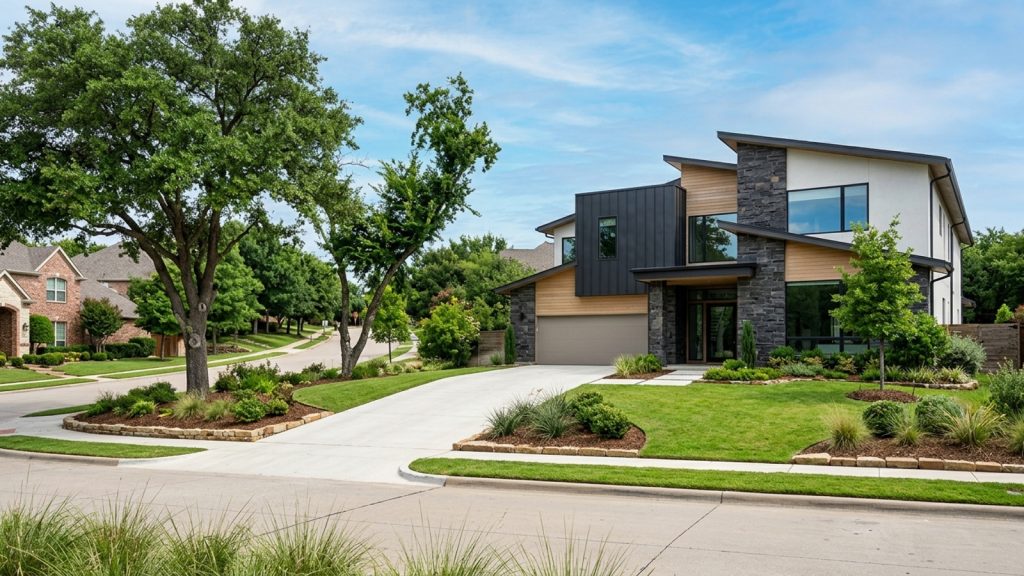
Allen, TX sits in Collin County, part of the broader Dallas-Fort Worth metro, and it offers buyers a mix of established subdivisions and newer master-planned communities. Recent MLS data shows roughly 410 active listings in Allen, TX, with homes spending about 34 days on the market – not lightning-fast, but not slow either.
The median home sale price as of mid-2026 runs around $504,725, though that number moves considerably depending on which part of the city you’re looking at, what era the home was built in, and whether you’re comparing a townhouse near a retail corridor to a large single-family on a golf-course lot. Allen has distinct zones, and understanding them saves you from casting too wide a net.
How Allen Communities Are Laid Out
Allen sits just north of Plano and south of McKinney, with US-75 running straight through it. Forget the traditional grid of city blocks – this city is organized almost entirely around subdivisions and master-planned communities, each with its own character and entry points.
The western side of the city tends toward larger, golf-course-adjacent developments. Move toward the central and eastern portions and you’ll find a mix of older construction and commercial districts. Knowing where those dividing lines fall makes a real difference when you’re weighing commute times against home style preferences.
Collin County Context
Allen’s position within the Dallas-Fort Worth metroplex puts residents within reach of major employment hubs in neighboring cities, and the US-75 corridor is a direct line into downtown Dallas for anyone commuting that direction. The local median household income sits at roughly $135,358 – well above the national median of $83,181 – which shapes both the housing stock and the retail landscape you’ll encounter day to day.
Daily errands are largely solvable without leaving city limits. Regional shopping and dining destinations exist inside Allen itself, which matters more than it sounds once you’ve settled in.
Using This Guide to Find Your Area
Picking a location in Allen comes down to comparing concrete data points – dominant home types, typical price ranges, age of the housing stock, distance to major roads, and what retail or park access looks like on a Tuesday afternoon. Subjective impressions only get you so far. Measurable factors are what you take to the negotiating table.
Grouping Areas by Home Type and Era
Allen’s inventory of roughly 410 available homes at any given time spans a wide range of architectural styles and property types. Attached townhouses near retail centers, traditional brick single-family homes from the late 1990s and early 2000s, newer master-planned builds with modern layouts – they’re all here, and they don’t price the same.
About 338 homes sold in a single month based on recent data, which tells you turnover is steady across community types. If you have a specific amenity in mind – a community pool, an open floor plan, walkable retail – the master-planned developments are where to start that conversation.
Detached Single-Family Properties
Most of Allen’s residential landscape is detached single-family homes, and established subdivisions like Custer Meadows and North Allen are good examples of what that looks like – traditional brick-exterior houses on standard lots, mature trees, familiar suburban streetscapes.
Prices in these areas hover near the citywide median of $504,725, with larger properties pushing comfortably above it. If you’re targeting an established subdivision, build time into your due diligence to review the age of the roof, HVAC systems, and interior finishes. Homes from that era often need updates, and the cost difference matters when you’re working a budget.
Townhomes and Attached Options
For buyers who want lower-maintenance living, there are solid attached-home options scattered across the city. Twin Creeks Watters Townhomes offer attached living spaces where exterior maintenance is typically handled through a homeowners association – fewer Saturday chores, higher monthly carrying costs.
The Village at Allen is a different animal entirely: a mixed-use area that blends apartments and attached housing with immediate access to shopping and dining. If walkability and retail access rank high on your list, it’s worth a look. Private yard space, less so.
New Construction and Master-Planned Areas
Star Creek, located in southwest Allen, is one of the larger master-planned communities featuring modern-style homes built within the last couple of decades. Cottonwood Creek is another newer-construction option, offering a mix of single-family homes and townhouses with built-in neighborhood amenities.
One thing to check before you fall in love with a floor plan: the HOA dues in these communities vary, and they can add up.
Profiles of Distinct Allen Communities
The Zillow Home Value Index puts the typical Allen home value at around $517,494 for 2026, but individual neighborhoods have their own pricing baselines that can sit meaningfully above or below that figure. Lot size, home age, and proximity to major roads all move the number.
The primary factors that differentiate these neighborhoods aren’t hard to pin down: access to parks, whether there’s a golf course, and distance to US-75. Start there.
Twin Creeks and Watters Crossing
Twin Creeks is one of Allen’s most prominent master-planned communities, built around an Arnold Palmer-designed golf course. The neighborhood also includes a swim center, local lakes, and access to Spirit Park. These are large, established single-family homes with mature landscaping and well-maintained streetscapes.
Watters Crossing sits nearby and has its own draw – proximity to Watters Creek Village, a major local shopping and dining destination. Different vibe from the golf-course side of things, but the housing stock is similarly established.
Angel Field West and The Village at Allen
Angel Field West adds another option for buyers looking at single-family homes, with lot sizes and home styles that reflect the broader building trends of Collin County over the last two decades. It’s a straightforward residential subdivision without a defining amenity anchoring it, which keeps it comparatively under the radar.
The Village at Allen is about as far from that as you can get. It’s a mixed-use district, and buyers here are trading private yards and quiet residential streets for immediate access to commercial space. Different priorities, different buyer.
Market Statistics and Local Resources
Allen’s housing market is currently sitting at about 3.7 months of supply – balanced enough that neither side has a dramatic advantage. Homes are selling for roughly 98.4% of list price on average, and about 17% of properties close above asking. That last number is worth keeping in mind if you find yourself in a multiple-offer situation.
Purchase price is only part of the cost equation. Ongoing homeownership costs, school district boundaries, and public safety data all belong in your due diligence process.
Looking Up Local Crime Data
The Allen Police Department maintains an official Community Crime Map accessible through allenpolice.org and communitycrimemap.com. The data refreshes every eight hours and covers a rolling 30-day window, with filters for date, location, and incident type.
You can also sign up for automated email alerts or submit anonymous tips through the same portal. It’s a straightforward tool – use it before you make an offer on a specific address.
School District Boundaries
Most of Allen falls within the Allen Independent School District, which also covers portions of neighboring McKinney, Plano, and Parker. The district runs numerous elementary and middle schools, all feeding into Allen High School – home of the Allen Eagles.
Attendance zones are set entirely by property address. Don’t assume a subdivision falls within a particular school’s boundary just because it’s nearby – pull the official boundary maps from the Allen ISD website and confirm the specific campuses before you close.
Frequently Asked Questions
Which neighborhoods in Allen, TX are zoned for the highest-rated Allen ISD schools?
School attendance depends entirely on the property address. Most of the city falls within the Allen Independent School District, with all students eventually feeding into Allen High School. To find out which elementary and middle schools serve a specific subdivision, check the official boundary maps on the Allen ISD website.
What are the most affordable neighborhoods to buy a house in Allen right now?
With the citywide median sale price at around $504,725, buyers looking for lower entry points should consider attached housing options like the Twin Creeks Watters Townhomes or properties near The Village at Allen. Older construction and smaller square footage will also pull a price below that median.
How do established communities like Twin Creeks compare to newer developments in West Allen?
Twin Creeks has mature trees, an Arnold Palmer-designed golf course, and access to Spirit Park – it’s an established community with a lot of infrastructure already in place. Newer master-planned developments like Star Creek in southwest Allen trade that maturity for modern-style homes and more recently constructed community amenities. Neither is objectively better; they just serve different priorities.
Which Allen neighborhoods offer the easiest access to US 75 for commuting to Dallas?
The central and eastern portions of Allen sit closest to the US-75 corridor. Watters Crossing and The Village at Allen both offer quick highway access for commuters heading into the broader Dallas-Fort Worth metroplex.
Are there specific Allen neighborhoods with unusually high HOA fees or strict property restrictions?
Master-planned communities like Twin Creeks, Star Creek, and Cottonwood Creek all have active homeowners associations governing property restrictions and maintaining amenities like community pools and parks. Fee schedules vary – request and review the full HOA documents for any specific property before you make an offer.
Where can buyers find new construction homes versus older, established neighborhoods in Allen, TX?
For newer construction, focus on master-planned communities like Cottonwood Creek and Star Creek, which offer modern single-family homes and townhouses. For established homes on mature lots with more traditional layouts, look at subdivisions like Custer Meadows and North Allen.
Planning to sell? Learn more about Why Sellers Hire Bale Real Estate Group.
Planning to buy? Learn how Bale Real Estate Group helps buyers evaluate homes and navigate their purchase. Why Buyers Choose Bale Real Estate Group.