
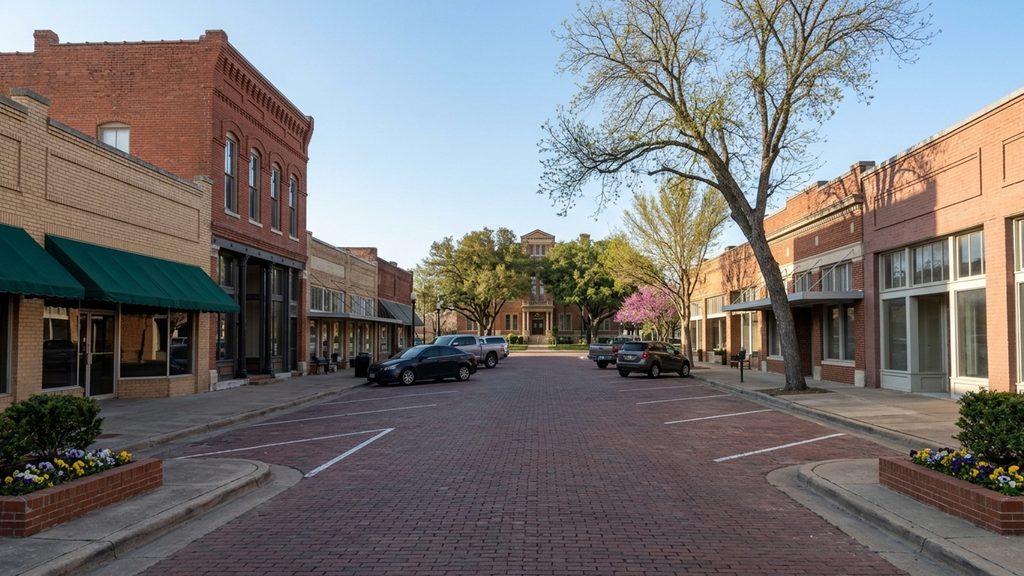
McKinney’s story comes down to two major bursts of growth separated by a century. The city was founded in 1848 to serve as the Collin County seat, built around a central courthouse square that still defines its layout. For decades it operated as a railroad and cotton town, leaving behind a core of 19th-century commercial buildings and early-20th-century houses.
The historic town is a small central footprint, while the housing market you’d shop today is overwhelmingly the result of a suburban boom that began in the 1990s. Recently, homes in McKinney sold after a median 65 days on the market, which gives buyers room to negotiate. The sections below explain how that history shapes where the older and newer homes sit.
Key Takeaway
McKinney began in 1848 as the Collin County seat and grew slowly as a railroad and cotton town around its courthouse square, until a suburban boom from the 1990s onward made it one of North Texas’s larger cities. To see that history in person, start at the historic downtown square. For a closer look at 1800s homes, Chestnut Square Historic Village is the alternative.
Who This Guide Is For
You’re curious about how McKinney became the city it is, or you’re considering a move there and want to understand how its history shapes where the older and newer homes sit.
How McKinney Grew over Time
McKinney’s history is defined by its 1848 founding as the Collin County seat and a much later suburban boom. It wasn’t the original seat of Collin County; that was Buckner. Because Buckner wasn’t within three miles of the county’s center, the state legislature made McKinney the new seat in 1848.
The historic town is a small core, and most homes on the market today come from recent growth. Across all property types, homes recently sat on the market for a median of 65 days and sold at roughly 97.5% of their list price. Buyers in today’s McKinney generally have room to negotiate.
If you want the story in order, the timeline section below runs from the 1848 founding through the growth years. If you’re planning a visit with a few hours to spare, go to the historic places section and start with downtown. If you’re deciding between an older home with character near downtown and a newer home in a planned community, read the section comparing those two options, then check the at-a-glance figures. For quick facts, the county, the name origin, whether McKinney belongs to the Dallas area, jump straight to the FAQs. Check out our guide on moving to McKinney for more details on relocating.
A Timeline of McKinney’s Growth
The physical layout of McKinney traces directly back to its origins as a government center and agricultural hub. Over the decades, the city evolved from a raw frontier settlement into an industrial cotton processing town, and eventually into a major residential suburb.
Each of those eras left a different mark on the local housing supply and commercial districts, which is exactly why the city looks the way it does today.
1848: Founding as the Collin County Seat
Collin County needed a central seat of government, and McKinney was laid out specifically for that role. Named for Collin McKinney, the location was chosen because it sat closer to the county’s center than the original seat, Buckner. Two sites were voted on for the relocated seat, and heavy rains kept voters from a competing site near Sloan’s Grove from reaching the polls, securing the win for McKinney.
The town was planned around a courthouse square, which is why downtown still has that layout today. The first non-home structure was a place of worship built in April 1848, and the Lovejoy Store was moved to the new town square the following month.
Most of what visitors see downtown dates from later rebuilding. Little or nothing from the 1840s frame town is likely to survive, so don’t assume a building is original without checking its historical marker or museum record.
1870s to 1920s: Railroad, Cotton, and the Courthouse Square
The arrival of the Houston and Texas Central Railway in 1872 connected McKinney and Plano to tracks reaching Houston. The subsequent arrival of the Missouri, Kansas and Texas Railroad in 1881 further expanded trade. Cotton drove the local economy, funding the brick commercial buildings and Victorian homes built around downtown.
During this era, McKinney operated cotton mills, cotton gins, a cotton compress, and a cottonseed oil mill. The county courthouse on the square was rebuilt, and the old Collin County Courthouse now operates as the McKinney Performing Arts Center. The town’s wealth rested entirely on one crop, which set up the slow decades that followed when the cotton industry declined.
1930s to 1980s: A Small County Seat
The Great Depression and the decline of cotton slowed McKinney’s economy while nearby Dallas grew rapidly. The town stayed a modest county seat for decades, eventually adopting a commission form of government in 1913 and slowly evolving toward a commuter role.
That long period of slow growth is a big reason downtown McKinney’s historic buildings are still standing. Because there was little economic pressure to tear down and rebuild, much of the downtown fabric survived rather than being redeveloped. For home shoppers, relatively few homes date from these decades compared with what came later. Compare the year-built on listings rather than assuming a mid-century construction date.
1990s to Today: Rapid Suburban Growth
Highway access and the northward spread of the Dallas area turned McKinney into a fast-growing suburb starting in the 1990s. Master-planned communities and large employers transformed the area, bringing national recognition. McKinney was ranked No. 1 on Money magazine’s Best Places to Live list in 2014, with the publication noting the business environment and quality development. You can review current major employers in our job market guide.
The boom means historic McKinney is a small slice of today’s city. Most of its homes, roads, and shopping centers are recent additions, and this growth brings ongoing construction and traffic. Check our getting-around page for details on local routes and commutes.
Where to See McKinney’s History
McKinney preserves its 19th-century roots in a few concentrated areas near the center of town. These sites offer a look at the commercial and residential architecture that defined the city before the modern suburban expansion. Because the historic locations are close to one another, you can walk between the major landmarks in a single afternoon. For attractions beyond history, see our guide to things to do in McKinney.
Historic Downtown McKinney
The McKinney Commercial Historic District, centered on the historic courthouse square, was listed in the National Register of Historic Places in 1983. A walk through the district turns up brick storefronts and historical markers detailing the city’s commercial past. The Collin County History Museum is housed in a historic downtown building, specifically the 1911 federal post office building located one block off the square at Chestnut and Virginia Streets.
The museum is open Fridays and Saturdays from 11 a.m. to 5 p.m., with a $5 general admission for adults. Downtown gets busy during festivals and weekend evenings, and parking can be tight. Check the McKinney Main Street event calendar and plan your parking before you go.
Chestnut Square Historic Village
Chestnut Square Historic Village is a collection of preserved 19th- and early-20th-century homes and buildings moved or kept near downtown. It reflects life in North Texas from 1850 to 1940, showing how residents lived during the cotton era. The village grew out of preservation efforts between 1973 and 1987, when the Heritage Guild of Collin County acquired and relocated several historic homes, including the Dulaney, Faires, Taylor, and Johnson houses.
The organization also runs a Holiday Tour of Homes tradition that began in 1973. Interiors are generally seen on guided tours that run on a set schedule, so you can’t simply drop in anytime. Check tour days and times with Chestnut Square before making the trip.
Comparing Older and Newer Homes in McKinney
The housing market in McKinney splits clearly between the historic core and the modern subdivisions. Deciding where to buy depends on whether you prioritize original architectural character or modern community amenities. Reviewing the pros and cons of living in McKinney can help clarify which lifestyle fits your goals.
With about 4.3 months of supply across all homes recently, the market is relatively balanced, giving buyers room to negotiate on price or repairs. Pulling year-built and price comparisons between older and newer homes helps clarify the real cost difference.
Older Homes Near Downtown
The historic housing is concentrated in a small area around the square. You can see how these neighborhoods align with local boundaries on our zip codes page. The city has historic preservation rules and may require approval for exterior changes inside designated districts. Owners in McKinney’s designated historic areas may be eligible for a city property tax incentive tied to preservation, such as the Rehabilitation Incentive or the Preservation Incentive, which require minimum investments of $10,000 and $5,000 respectively within a 12-month period.
If you want to replace original windows on a home in a designated district, confirm with the city whether a Certificate of Appropriateness is needed before budgeting the project. Older foundations, wiring, and plumbing require a thorough inspection. That extra layer of regulation is real: confirm an address’s historic designation with the city’s planning department before making an offer.
Newer Homes in Master-Planned Communities
Most of today’s inventory comes from the growth decades. If you’re looking for a lower entry point, townhouses in these newer areas had a median sale price of roughly $370,000 recently, down 5.5% year over year (based on 22 townhouse sales, so treat the trend with caution). You can explore these developments further in our neighborhood profiles.
For full property tax math and overall expenses, review our cost of living guide, and check our housing market page for broader pricing trends. Newer communities often carry homeowners association dues and may sit in special taxing districts that add to your annual bill. Ask the HOA for current dues and check the property’s full combined tax rate on the county appraisal district site before comparing monthly costs with an older home.
At a Glance
- Median sale price, single-family: $519,793, down 1% year over year (90 days ending 2026-09-30, 636 sales)
- Median sale price, townhouse: $370,004, down 5.5% year over year (90 days ending 2026-09-30; based on only 22 townhouse sales, so treat with caution)
- Median days on market, all homes: 65 (90 days ending 2026-09-30)
- Sale-to-list ratio, all homes: 97.5% (90 days ending 2026-09-30)
- Share of homes sold above list, all homes: 7.8% (90 days ending 2026-09-30)
- Months of supply: 4.3 all homes, 4.2 single-family, 5.9 townhouse (townhouse based on 22 sales) (90 days ending 2026-09-30)
- Homes for sale (inventory), all homes: 934 (90 days ending 2026-09-30)
- Median price per square foot: $209 single-family, $191 townhouse (townhouse based on 22 sales) (90 days ending 2026-09-30)
McKinney History FAQs
Why Is McKinney, Texas Famous?
McKinney is known for its role as the Collin County seat since 1848 and its preserved historic downtown square, where the McKinney Commercial Historic District was listed in the National Register of Historic Places in 1983. It also gained national recognition during its rapid growth years, notably when Money magazine named it the No. 1 Best Place to Live in America in 2014.
What Is the Origin of the Name McKinney?
The city and county are named for Collin McKinney. He was one of the first settlers of the county and a signer of the Texas Declaration of Independence.
What Movie Was Filmed in McKinney, Texas?
McKinney has a documented film history, most notably serving as a primary location for the 1974 classic family film “Benji,” which used the Dowell House as a haunted house set. Other productions that filmed scenes in the city include the TV series “Walker, Texas Ranger” (1993-2001) and features like “An American Story” (1991), “A Promise to Carolyn” (1995), “Cadillac Jack” (1997), “The Prodigy” (2000), and “The Final” (2009). The city received an official “Film Friendly Texas” designation from the Texas Film Commission in 2019.
Is McKinney, Texas a Wealthy Town?
The median sale price for a single-family home in McKinney was roughly $519,793 recently, down a modest amount year over year. Prices have held relatively steady rather than climbing sharply. See the housing market page for broader pricing trends.
What County Is McKinney, TX In?
McKinney is located in Collin County, where it has served as the county seat since 1848. Check the city limits map to confirm whether any specific property extends into a neighboring county.
Is McKinney, TX Part of Dallas or DFW?
McKinney is its own independent city, not part of Dallas, but it belongs to the Dallas-Fort Worth metropolitan area. Check our getting-around page for distances and daily commute times to Dallas.
How Many Residents Does McKinney, TX Have, and How Fast Has It Grown?
The latest U.S. Census Bureau report estimated McKinney’s population at 236,001 as of July 2025. The city has grown rapidly over the past few decades, expanding from a population of just 21,283 in 1990.
Does McKinney, TX Flood?
Parts of McKinney lie near creeks and designated river floodplains, and the city restricts new development in areas that have a 1% chance of flooding in any given year. As of May 2026, FEMA issued new preliminary Flood Insurance Rate Maps covering portions of Collin County. Look up any specific property on the FEMA flood map and ask the seller for its flood history before buying.
Sources
- Redfin: Data Center
- TSHA: Collin County
- City of McKinney: History
- TSHA: McKinney, TX
- City of McKinney: Our History
- PR Newswire: Doing Business in McKinney, TX
- Visit McKinney: Collin County History Museum
- Chestnut Square: Museum
- City of McKinney: FAQ
- City of McKinney: HNIZ Checklist and Application
- Texas Governor’s Office: Texas Classics Trail
- U.S. Census Bureau: McKinney city, Texas
- City of McKinney: Floodplain Management