
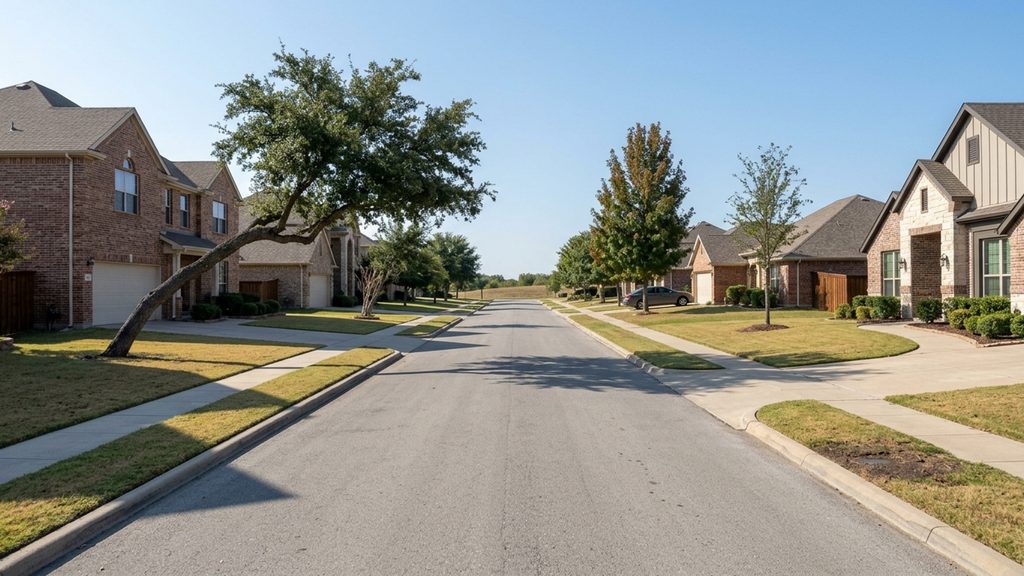
Allen sits in a humid subtropical climate zone, which means the area gets about 37 inches of rain a year and runs through distinct, active seasons. The daily forecast tells you what to wear; the broader patterns tell you how a house holds up.
In North Texas, a home’s condition is directly tied to what it endures year after year. Spring storms, summer heat, and winter cold each leave specific marks on local properties, and knowing what those marks look like helps you know exactly what to inspect before making an offer.
Key Takeaway
Allen has hot, humid summers, short winters, and a spring hail season, so the weather questions that matter most for a buyer are about the house: the roof, the foundation, and the insurance deductible. Summer is a workable time to shop, because in the 90 days ending September 30, 2026, Allen homes sold close to list price, which leaves room to negotiate weather-related repairs. If you’d rather tour properties in comfortable weather, the milder fall months are the alternative.
Who This Guide Is For
You’re considering a home in Allen and want to know what the weather is like through the year, what it means for the house you pick, and the costs that come with it.
What Is the Weather Like in Allen, TX?
The Dallas-Fort Worth area, including Allen, averages 37.01 inches of precipitation annually and sees a normal annual snowfall of just 1.6 inches. The weather that matters most to a buyer, though, is what it does to the house. Spring hail beats up roofs, summer droughts shrink the clay soil under slabs, and occasional hard freezes test exposed pipes.
These three events drive the bulk of local home repairs and insurance claims. Because they’re predictable, you can plan your house hunt around them. The summer market often gives buyers enough time to check for weather-related wear before closing.
Allen Weather by Season
The local calendar revolves around a few intense stretches separated by mild transitions. March through June brings the most volatile conditions; late summer delivers prolonged heat.
A property you tour in October has just survived the dry summer. A home you walk through in May is sitting right in the middle of storm season.
Spring: Storm and Hail Season
March through June brings both the mildest temperatures and the most volatile weather to Collin County. According to the National Weather Service’s climate narrative for the metroplex, thunderstorms and severe weather peak during the spring. Large hail, damaging winds, and tornadoes occur in the region nearly every year.
Outdoor plans and home showings get interrupted by storm days regularly during these months. The downside is that the prettiest touring weather of the year coincides with the season most likely to damage a roof. A house that looked perfect in April may have new hail damage by June.
Summer: Long Heat and Dry Soil
July and August deliver the most intense heat of the year: triple-digit days, high humidity, and very little rain. The ground bakes, and air conditioners run constantly. You can read more about planning around the heat when exploring things to do in Allen.
During these dry months, the soil shrinks away from concrete slabs. It’s the season of the biggest electricity bills and the most soil movement under foundations, which makes it expensive to live through but an ideal time to spot structural issues.
Fall: The Mild Stretch
October and early November bring the most comfortable temperatures of the year, along with a secondary peak in rainfall. This is the natural time for outdoor life and for touring homes without fighting the heat.
The catch is that fall can bring a second, smaller round of severe storms. Mild temperatures don’t mean the hail risk is completely over.
Winter: Short, but Freezes Happen
Winters in Collin County are brief and mostly mild, though January brings the lowest temperatures of the year. Ice storms are typically more disruptive than snow. The reference event for local winter extremes is the February 2021 Texas freeze, which placed the entire region under a Winter Storm Warning with sub-zero wind chills for days.
You can read more about winter road conditions when figuring out getting around Allen. Freezes are rare enough that many North Texas homes aren’t built for them, and one bad week can mean burst pipes and icy roads that shut down a city not equipped for ice.
How Allen’s Weather Affects a House
The elements leave specific marks on Collin County homes, and knowing what to look for can save you thousands of dollars. General home inspections cover the basics, but weather-specific wear often requires specialized professionals.
Pay close attention to the top, bottom, and interior plumbing of any property you consider. Asking the right questions about past repairs and current materials is just as important as the physical inspection.
Roofs and Hail
Hail is the most common weather claim in the area. When you’re looking at a home, ask the seller for the roof’s age, the installation invoice, and whether any hail or wind claims were filed recently. If the home has a documented impact-resistant (Class 4) roof, ask your insurance agent whether you qualify for a premium discount. A newer rated roof lowers the odds of an early claim against a percentage deductible.
A roofer’s inspection is separate from a general home inspection, and you should also check whether the HOA restricts roofing materials before planning a replacement. Hail damage isn’t always visible from the ground or obvious to a general inspector. A roof replaced under a seller’s claim may still carry a lower-grade shingle, so you’re relying on documentation as much as a visual check.
Foundations and Clay Soil
Much of Collin County sits on Houston Black clay, a soil type that shrinks when dry and swells when wet. The hot, dry summer months are when slabs move the most, causing stair-step brick cracks and sticking doors. Ask the seller for foundation repair records, the repair company’s name, and whether any warranty transfers to a new owner.
If you have doubts, hire a structural engineer to review the slab. Soil movement is ongoing, so a past repair doesn’t end the issue. Keeping moisture around the slab steady becomes part of owning the house, and a warranty is only as good as its transfer terms.
Pipes and Power in a Hard Freeze
Building on the lessons of the 2021 winter storm, check how a home’s plumbing is routed. Find out where the water lines run, especially if they sit in exterior walls or unheated attics. Locate the main water shutoff so you can act quickly if a freeze hits.
Check for irrigation backflow preventers that need winterizing, too. You usually can’t see where the pipes run until something fails, and freeze-prone plumbing in an attic or exterior wall is rarely disclosed as a defect because it functions fine for most of the year.
Weather Costs to Budget For
Owning a home in North Texas comes with specific carrying costs tied directly to the climate. Beyond your mortgage and property taxes, plan for insurance deductibles and high cooling bills.
These expenses vary widely from one house to the next based on the home’s age, materials, and efficiency. Getting actual quotes and usage history during your option period is the only way to know your true monthly costs.
Homeowners Insurance and Wind/hail Deductibles
Many Texas homeowners policies set a separate wind and hail deductible as a percentage of the dwelling coverage, rather than a flat dollar amount. For a home insured near Allen’s median sale price of $492,515, a 2% deductible means you’d pay roughly $9,850 out of pocket before coverage kicks in for a roof replacement.
Get homeowners insurance quotes on the specific address during your option period, and ask each insurer to state the wind and hail deductible as a dollar amount. Premiums and deductible options vary by insurer, roof type, and claim history, so you won’t know your real number until you get quotes on the specific property.
Summer Electricity Bills
Air conditioning dominates summer utility bills in Collin County. Ask the seller to provide their past 12 months of electric bills, and note the age of the HVAC system and the condition of the attic insulation. You can read more about utility expectations in our overview of the cost of living in Allen.
The seller’s bills reflect their thermostat habits and household size, not yours. Treat their past statements as a floor-to-ceiling range rather than a strict forecast of what you’ll pay.
When to Shop for a Home in Allen
The summer market gives buyers the time they need to check a home’s condition. In the 90 days ending September 30, 2026, single-family homes in Allen took a median 46 days to sell, while townhouses sat for a median 137 days (based on 19 sales, so treat that figure with caution). That pace gives you time to schedule a roofer and a structural engineer before committing.
Because homes sold at a median 97.4% of their list price during this window, you have room to negotiate weather-related repairs if an inspection turns up roof or foundation issues. Single-family homes made up 270 of the 290 total sales, giving you a wide choice of detached homes to filter by roof age and claim history.
If you want the most time and negotiating room to get a roof and foundation inspected, Allen townhouses offer a slower pace. If you’d rather tour in comfortable weather, the milder fall months are a good alternative to the summer heat. You can explore more market trends in our Allen housing market overview or our guide to buying a home in Allen.
Questions to Ask Before You Buy in Allen
Deciding when and what to buy in North Texas means weighing the weather against your budget and timeline. Before you start touring homes, review these questions to narrow down your strategy.
- Are you shopping during or just after spring storm season? If a recent hailstorm hit the area, go straight to the roof and insurance sections above before you make an offer.
- Is the house older, with an original roof or a slab that’s never been checked? Focus on the foundation and clay soil details, then ask the seller for repair history.
- Could your budget absorb a hail deductible set as a percentage of the home’s insured value rather than a flat amount? If not, the insurance section matters more to you than the temperature charts.
- Do you need to tour in comfortable weather, or do you want extra time and negotiating room? Compare the mild fall stretch with the summer shopping window.
For a broader look at what it’s like to live here, read about the pros and cons of living in Allen or review our tips for moving to Allen.
At a Glance
- All homes: median sale price $492,515, down 1.5% year over year (90 days ending Sept. 30, 2026; 290 sales)
- All homes: median 49 days on market; sold at a median 97.4% of list; 10.8% sold above list (90 days ending Sept. 30, 2026)
- All homes: median $213 per square foot; 3.8 months of supply; 363 homes for sale (90 days ending Sept. 30, 2026)
- Single-family homes: median sale price $505,299, down 1.8% year over year (90 days ending Sept. 30, 2026; 270 sales)
- Single-family homes: median 46 days on market; 11.3% sold above list; 3.4 months of supply; 297 for sale (90 days ending Sept. 30, 2026)
- Townhouses: median sale price $435,005, down 4.6% year over year; median $224 per square foot (90 days ending Sept. 30, 2026; based on only 19 sales, so treat with caution)
- Townhouses: median 137 days on market; 98% sale-to-list; 5.3% sold above list; 8.5 months of supply; 54 for sale (90 days ending Sept. 30, 2026; based on 19 sales)
Allen, TX Weather FAQs
Does It Snow in Allen, Texas?
Yes, occasionally, but snowfall is light and doesn’t stay long. The normal annual snowfall for the Dallas-Fort Worth metro area is 1.6 inches. Ice storms are typically a bigger disruption to the region than accumulating snow.
What Is the Coldest Month in Allen, TX?
January is the coldest month of the year. The annual mean temperature for the metro area is 66.6°F, with winter bringing brief stretches of freezing temperatures.
Is Allen, TX Humid?
Yes, especially in the summer, which is when the heat feels the worst. The metro area sees an annual average relative humidity of 66%. Relative humidity stays present through the summer months, with July averaging 61% and August averaging 59%.
Is Allen, TX Getting Hotter?
Check the Office of the Texas State Climatologist for current climate trend reports regarding North Texas. Historical data shows the area already experiences long stretches of summer heat, with July and August bringing the highest temperatures of the year.
What Natural Disasters Happen in Allen, TX?
Collin County carries a “Relatively High” composite rating for natural hazard risk under FEMA’s National Risk Index. This is driven primarily by “Very High” ratings for tornado and hail risk. The county also sees “Relatively High” risk ratings for riverine flooding, strong wind, cold waves, heat waves, and winter weather.
Is Allen, TX in a Flood Zone?
Most of the city is not in a mapped flood zone, but parts near creeks are. The City of Allen participates in the National Flood Insurance Program, and FEMA has released updated preliminary Flood Insurance Rate Maps for Collin County. Look up your specific address on FEMA’s Flood Map Service Center, and remember that standard homeowners policies don’t cover flood damage.
Does Allen, TX Have Tornado Sirens?
Yes, the City of Allen operates 26 outdoor warning sirens. They’re tested audibly at noon on the first Wednesday of every month, though tests are skipped during actual severe weather. Sirens are meant to warn people outdoors, so use a weather radio or phone alerts when you’re inside.
What Is the Best Month to Move to Allen, TX?
Weather-wise, October tends to be the most comfortable month for a move. Late spring brings storm days, and July through August brings peak heat. You can read more about planning your relocation in our tips for moving to Allen.
Sources
- Redfin: Data Center
- National Weather Service: 1991-2020 Climate Normals
- Wikipedia: Climate of Dallas
- National Weather Service: DFW Records and Normals
- National Weather Service: DFW Climate Narrative
- NOAA NCEI: The Great Texas Freeze of February 2021
- Soils for Teachers: Texas State Soil Booklet
- City Directory: Collin County FEMA Risk Index
- FEMA: Community Status Book for Texas