
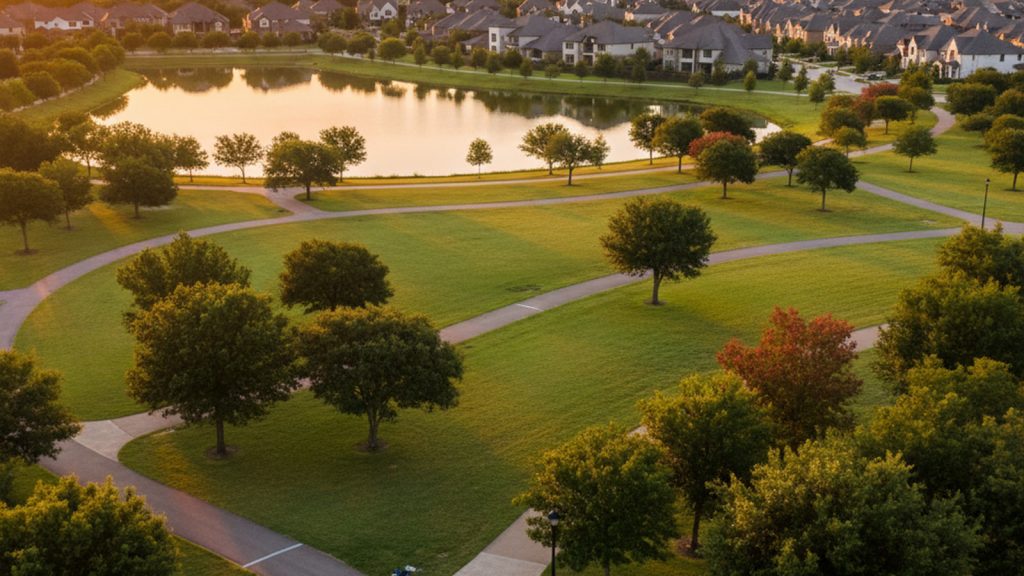
If you are looking at the Dallas-Fort Worth metroplex and trying to decide where to plant your roots, you have almost certainly heard the buzz about Frisco. It is not just a suburb anymore; it has become a destination in its own right.
People call it “Sports City USA,” and while the stadiums and headquarters are impressive, that is usually not the main reason people buy a home here. You are likely looking for safety, solid schools, and a community that feels worth the investment.
The accolades back up the hype. In recent 2024 and 2025 rankings, Frisco has been named the #2 Safest City in the U.S. by MoneyGeek and recognized by Fortune as one of the Best Places to Raise a Family. But let’s be real for a moment—that reputation comes with a price tag.
Living here isn’t cheap. The cost of entry has risen significantly over the last decade. The real question isn’t just “is it good,” but “is it worth the premium?” For most of the clients I talk to, the answer is a resounding yes, provided the budget numbers make sense for their financial goals.
The Primary Driver: Frisco Independent School District (FISD)
Let’s get right to the biggest factor for most households moving here: the schools. Frisco Independent School District (FISD) operates differently than almost any other district of its size in Texas, and it is a huge selling point.
Most fast-growing suburbs build massive high schools that house 4,000 or 5,000 students. FISD took a different path. They use a “Small School Model,” which means they cap high school enrollment at lower numbers. The philosophy is simple: with fewer students per school, more kids get the chance to make the varsity team, lead a club, or get a role in the school play. It is about participation and opportunity, not just warehousing students.
The results speak for themselves. The district consistently pulls in top marks, including an “A” rating (100/100) from the Texas Education Agency for the 2024-2025 school year. The graduation rate sits impressively high at around 98.8%.
Another practical perk is the layout. Because the district builds more, smaller schools, they are embedded deep within the neighborhoods. For many residents, the elementary or middle school is just a short walk or bike ride away, which adds a layer of community feel that is hard to replicate in older, more spread-out districts. If you are comparing areas, seeing how Frisco ISD vs. Plano ISD stacks up is often the first step in your research.
Safety First: Crime Rates in Frisco vs. Dallas
When you are moving to a new area, “safety” is often a vague term. In Frisco, however, we can look at hard numbers. The contrast between Frisco and the denser urban core of Dallas is stark.
Recent data paints a clear picture. While no city is immune to crime, Frisco’s violent crime rate is exceptionally low—hovering around 86 incidents per 100,000 residents, which is a fraction of the national average. This is a huge reason why MoneyGeek’s 2025 study highlighted the city for its low “societal cost of crime.”
You will still see property crime occasionally—mostly things like theft from unlocked cars—but the numbers are still significantly below what you would see in Dallas proper.
Beyond the stats, there is a tangible “suburban feel” here. The streets are well-lit, the police presence is active and visible, and community engagement is high. The Fire Department also holds an ISO Class 1 rating, which is the highest possible score for fire protection capabilities (and can sometimes help with your home insurance premiums).
Beyond Football: Family-Friendly Attractions & Amenities
The “Sports City USA” nickname is well-earned, but you don’t have to be a professional athlete to enjoy the perks. The city has done an incredible job of turning corporate HQs into public playgrounds.
Take The Star, for example. Yes, it is the World Headquarters of the Dallas Cowboys, but for locals, it is a place to grab dinner, let the kids run around on the turf field during events, or watch the massive Christmas spectacular in the winter.
Then you have PGA Frisco. This is a newer addition that has brought championship golf to the area, but they designed it with the community in mind. There is a massive putting green and entertainment district that is open to the public, making it a fun evening out even if you aren’t playing a full round.
For indoor fun, the city offers unique spots like KidZania and the National Videogame Museum. And I can’t forget the Frisco Public Library. They recently opened a new 158,000-square-foot facility that is an absolute showstopper—complete with a life-sized dinosaur skeleton that greets you when you walk in.
Looking ahead, the entertainment scene is only getting bigger. The Universal Kids Resort is slated to open in 2026. This theme park is designed specifically for younger children, further cementing Frisco as a hub for entertainment. If you are looking for things to do in Frisco with kids, the list is getting longer every year.
Where to Live: Master-Planned Communities with Top Amenities
Frisco is famous for its master-planned communities. If you aren’t familiar with the term, think of these as self-contained neighborhoods designed with lifestyle in mind. They almost always come with a Homeowners Association (HOA), but in exchange, you get access to incredible shared facilities.
When we talk about “amenity-rich” living, we are talking about developments like Newman Village, known for its art sculptures and plaza-style layout, or Phillips Creek Ranch, which features over 100 acres of green space, lakes, and parks. Another popular spot is The Trails, which integrates a golf course directly into the neighborhood layout.
These communities are connected by an extensive hike-and-bike trail system. You will often see neighbors out walking dogs or cycling on weekends. The design intent here is to get people out of their houses and into the common areas.
It is worth noting that these neighborhoods vary in style and price point. Checking out a best neighborhoods in Frisco guide can help you distinguish between the established areas with mature trees and the newer developments offering the latest in modern home design.
The Cost of Living Reality Check
Here is where we have to be realistic. Frisco offers a premium lifestyle, and the market reflects that. If you are moving from a high-cost coastal city, it might still look like a bargain, but for Texas, it is on the higher end.
As of late 2024 and early 2025, the median home price in Frisco generally hovers in the $695,000 to $725,000 range. That is significantly higher than the national and state averages. You are paying for the schools, the safety, and the manicured boulevards.
You also need to factor in property taxes. Texas has no state income tax, which is great for your paycheck, but we make up for it with property taxes. In Frisco, you should budget for a tax rate of approximately 2.0% to 2.5% of your home’s assessed value annually.
Rent is also competitive. If you aren’t ready to buy, a decent apartment or rental home will likely cost you around $1,900 a month or more, depending on the location and luxury level.
However, most residents feel the ROI is there. You are buying access to top-tier municipal services, parks that are manicured like golf courses, and infrastructure that works. It is smart to run the numbers on a cost of living in Texas breakdown to make sure your monthly budget aligns with the lifestyle you want.
Commute & Location: Access to Jobs
One of the reasons Frisco exploded in popularity is its location. It isn’t just a bedroom community; it is adjacent to some of the biggest employment hubs in North Texas.
Many residents work in the “Platinum Corridor” along the Dallas North Tollway. You are just a 10 to 15-minute drive from Legacy West in Plano, which houses corporate giants like Toyota North America, Liberty Mutual, and JPMorgan Chase.
Within Frisco itself, the “5 Billion Dollar Mile” and other commercial developments mean many people don’t even have to leave the city limits to go to work.
If you need to commute to Downtown Dallas, you are looking at a longer haul. Via the Dallas North Tollway, that drive can take anywhere from 35 to 50 minutes, and likely longer during peak rush hour. Traffic congestion is the inevitable side effect of such rapid growth, so that is something to keep in mind when choosing your specific neighborhood.
Summary: Pros and Cons of Raising a Family in Frisco
If you are skimming, here is the quick verdict on what life is actually like here.
Pros:
- Safety: Consistently ranked as a top safe city (MoneyGeek #2).
- Schools: The FISD small school model ensures high engagement and ‘A’ rated academics.
- Activities: Massive investment in youth sports, libraries, and parks.
- Infrastructure: Clean, modern roads and master-planned aesthetics.
Cons:
- Cost: Housing entry price is near $700k, which prices out many buyers.
- Taxes: High property tax rates (though no state income tax).
- Traffic: The Tollway gets congested, and infrastructure is constantly playing catch-up with growth.
- Climate: Summers are hot—triple-digit heat is standard in July and August.
Expert Guidance for Buying and Selling in Frisco
Navigating the Frisco real estate market takes more than just watching prices. The Bale Real Estate Group, ranked in the top 1% of North Texas Realtors, helps buyers and sellers understand how to position themselves based on current competition, not just past sales. From identifying the right neighborhoods to negotiating stronger terms, their approach is focused on preparation, strategy, and results.
Frequently Asked Questions
Is Frisco or Plano better for families?
This is the most common comparison we see. Plano is more established with mature trees and a slightly more central location, while Frisco is newer and still growing rapidly. Both have excellent schools, but if you prefer newer construction and modern master-planned communities, Frisco often wins out; if you want a more traditional neighborhood feel, Plano might be the pick.
Does Frisco TX have good public schools?
Absolutely. The Frisco Independent School District (FISD) is the primary draw for many new residents, boasting an “A” rating (100/100) from the Texas Education Agency. Their unique small-school model helps keep student-to-teacher ratios favorable and encourages higher student participation in extracurriculars.
Is Frisco expensive to live in?
Relative to the Texas and national average, yes, it is expensive. With median home prices around $700,000 and housing costs roughly 21% higher than the national average, it is a premium market. However, compared to tech hubs like California or New York, many buyers still find it offers significant value for the money.
What is the crime rate in Frisco, Texas?
Frisco is statistically very safe. The violent crime rate is exceptionally low—around 86 incidents per 100k residents—and it was recently ranked the #2 Safest City in the U.S. by MoneyGeek in 2025. While property crime exists, it remains far below the levels seen in major urban centers like Dallas.