Top 1% Frisco & Plano Realtors | Bale Real Estate GroupTop 1% Frisco & Plano Realtors | Bale Real Estate Group

Top 1% North Texas luxury real estate team with $50M+ in sales and 80+ 5-star reviews. Frisco, Plano, Preston Hollow & North Dallas.

  • Home
  • Search
  • Communities We Serve
    • Allen
    • Aubrey
    • Celina
    • Coppell
    • Dallas
      • Oakdale
    • Frisco
      • Chapel Creek
      • Country Club Ridge at The Trails
      • Custer Creek Farms
      • Edgestone at Legacy
      • Griffin Parc
      • Heather Ridge Estates
      • Newman Village
      • Park Place Estates
      • Phillips Creek Ranch
      • Richwoods
      • Shaddock Creek Estates
      • Starwood
      • Stonebriar
      • The Canals at Grand Park
      • The Fairways
      • The Hills of Kingswood
      • Villages of Stonebriar Park
    • McKinney
    • Park Cities
    • Plano
      • Avignon Windhaven
      • Cliffs of Gleneagles
      • Crystal Creek
      • Deerfield
      • Kings Gate
      • Lakeside on Preston
      • Normandy Estates
      • Shoal Creek
      • Wentworth Estates
      • Willow Bend Polo Estates
      • Willow Bend
      • Windrose Tower
    • Preston Hollow
    • Princeton
    • Prosper
    • Southlake
  • Buyers
    • Buying a Home in Dallas
    • 8 Steps to Buying a Home
    • First-Time Home Buyers
    • Smart Buyer Strategy
      • DFW Property Taxes
      • HOA Communities in North Texas
      • Homestead Exemptions
      • MUD and PID Districts
      • Cost of Home Ownership
    • Home Loan Process
      • Credit Score Requirements
      • Mortgage Pre-Approval
      • How Much Home Can You Afford?
      • Down Payment Options
      • Interest Rates Explained
    • Relocating to North Dallas
      • Choosing the Right Community & Location
      • School Districts
      • Commute Considerations
      • Community Comparisons
      • Cost of Living
    • New Construction Buyer Representation
    • Offer Strategy
      • What Happens After the Seller Accepts Your Offer on a Home?
    • Home Inspections
    • Buyer Closing Costs
    • Military & Veteran Services
    • Buying and Selling at the Same Time
      • Downsizing & Rightsizing
  • Sellers
    • Selling Your Home in North Dallas
    • 8 Steps to Selling a Home
    • Pre-Listing Appointment
    • Preparing Your Home for Sale
    • Certified Pre-Owned Home Listing Program
    • Marketing Your Home for Maximum Exposure
      • Professional Photography
      • Drone Photography
      • Zillow Showcase
      • Social Media Marketing
      • Digital Advertising
    • Strategic Pricing & Market Positioning
    • Seller Closing Costs & Net Proceeds
      • Calculate Your Estimated Seller Net Proceeds
    • Offer Strategy & Seller Protection
      • What Happens After You Accept an Offer on Your Home?
    • Buying and Selling at the Same Time
      • Downsizing & Rightsizing
  • Our Advantage
    • Why Sellers Hire Bale Real Estate Group
    • Why Buyers Choose Bale Real Estate Group
    • Meet the Team
    • Real Producers: Cover Story
    • Our Story
    • Client Testimonials
    • Proven Results
    • Certified Pre-Owned Home Listing Program
    • Zillow Showcase
    • Professional Home Staging
    • Concierge Vendor Network
    • Videos
  • Blog
  • Contact

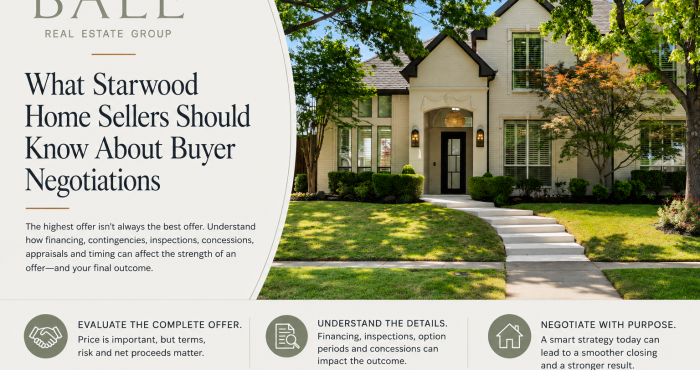
What Starwood Home Sellers Should Know About Buyer Negotiations

Receiving an offer on a Starwood home is an important milestone, but the highest purchase price does not automatically represent the strongest offer.

A luxury real estate contract contains numerous financial, timing and risk considerations that can affect the seller’s ultimate outcome.

Purchase price matters. So do financing strength, contingencies, option periods, requested concessions, appraisal considerations, closing timing and the buyer’s overall ability to complete the transaction.

For Starwood homeowners, evaluating these factors together can be particularly important because luxury transactions may involve substantial financial commitments and properties with distinctive characteristics.

Negotiation Begins Before the First Offer Arrives

A seller’s negotiating position is influenced by decisions made before the home ever reaches the market.

Preparation, property condition, pricing and marketing can all affect buyer interest.

A well-positioned property that generates strong demand may give a seller more negotiating leverage than a home that has remained on the market with limited activity.

This is why negotiation should be viewed as part of the entire listing strategy rather than something that begins only after an offer is received.

For more information, read How to Market a Luxury Home in Starwood Frisco TX.

Start With the Purchase Price—But Do Not Stop There

The purchase price is naturally one of the first terms sellers evaluate.

However, two offers with identical prices can create very different financial outcomes and levels of risk.

For example, one buyer might request significant seller concessions while another does not. One may have stronger financing or a larger down payment. Another may request a longer option period or have additional contingencies.

The offer should therefore be evaluated as a complete package.

Understand the Buyer’s Financing

When an offer involves financing, the strength of the buyer’s financial position deserves careful consideration.

Sellers and their Realtor may review available information regarding the buyer’s lender, pre-approval status, loan type, down payment and other relevant financing terms.

A high purchase price has limited value if the buyer cannot ultimately obtain the financing required to close.

That does not mean one financing structure is automatically superior to another. It means sellers should understand the financing behind the offer before making a decision.

Cash Offers Still Need Careful Review

A cash offer can remove some financing-related uncertainty, but it should not automatically be considered the best offer.

The seller should still evaluate price, proof of funds, option provisions, closing date, requested concessions and other contract terms.

A financed offer with stronger overall economics may be preferable to a lower cash offer depending on the seller’s priorities and circumstances.

The Buyer’s Down Payment Can Provide Useful Context

The amount a buyer intends to finance may affect different aspects of the transaction.

A substantial down payment may indicate financial strength, but sellers should avoid making assumptions based on a single number.

The broader financing package and lender information should be evaluated together.

The objective is to understand the likelihood that the buyer can perform according to the contract.

Option Periods Matter

In a Texas residential transaction, buyers may negotiate for an option period that gives them a contractual right to terminate during the agreed period.

The length and terms of that option period can affect the seller’s risk.

During this time, buyers commonly conduct inspections and evaluate the property more closely.

Sellers should therefore consider both the proposed option period and the likelihood that inspection findings could lead to additional negotiations.

Inspection Negotiations Can Change the Economics of the Sale

An accepted purchase price does not necessarily represent the final economic agreement.

After inspections, a buyer may request repairs, credits, price adjustments or other concessions.

Those requests can range from relatively minor items to significant concerns involving major systems or components.

How the seller responds should depend on the nature of the issue, the contract, market conditions, buyer demand and the seller’s overall objectives.

Knowing About Property Condition Beforehand Can Help

Inspection negotiations can be more difficult when the seller learns about significant property-condition concerns for the first time after accepting an offer.

Bale Real Estate Group addresses this through our Certified Pre-Owned Home Listing Program.

We provide a professional pre-listing inspection at our expense so sellers can identify potential concerns before the home reaches the market.

That early information can provide more time to investigate issues, obtain contractor opinions and determine whether repairs should be completed before listing.

Learn more in How Pre-Listing Inspections Help Starwood Home Sellers.

Seller Concessions Affect Net Proceeds

A buyer may request that the seller contribute toward certain allowable costs associated with the transaction.

When evaluating an offer, homeowners should consider the financial effect of requested concessions rather than focusing exclusively on the headline purchase price.

An offer at a higher price with substantial concessions may produce a lower seller net than another offer with a slightly lower price and fewer requested costs.

Understanding estimated net proceeds can help sellers compare offers more accurately.

Closing Date Can Be an Important Negotiating Term

The preferred closing date varies from seller to seller.

Some homeowners need time to purchase another property, relocate or coordinate a move. Others may prefer to close as quickly as reasonably possible.

An offer that accommodates the seller’s timing may have value beyond the purchase price.

When multiple offers are available, closing flexibility can become an important differentiator.

Possession Should Be Evaluated Separately From Closing

The date ownership transfers and the date the seller physically leaves the property do not always have to be identical.

Depending on the contract and negotiated terms, a seller may request temporary possession after closing or another arrangement appropriate to the transaction.

Any possession agreement should be reviewed carefully because it can create additional responsibilities and risk for both parties.

Appraisal Risk Can Matter in a Luxury Transaction

When a buyer is obtaining financing, the lender may require an appraisal.

This can be especially relevant for distinctive luxury properties where the most appropriate comparable sales may differ in size, renovations, lot characteristics or other important features.

A buyer may be willing to pay a particular price, but the lender’s appraisal process is separate from the buyer’s personal valuation of the property.

Sellers should understand whether an offer contains appraisal-related provisions and what those provisions could mean if the appraisal is below the contract price.

Comparable Sales Can Strengthen the Seller’s Position

Strong pricing analysis before listing can also help during negotiations.

Understanding recent sales, current competition and the property’s individual advantages gives the seller a stronger basis for evaluating whether an offer reasonably reflects market value.

This becomes particularly important when responding to a buyer seeking a substantial price reduction.

Read How to Price a Luxury Home in Starwood Frisco TX for a deeper discussion of Starwood pricing strategy.

Know What Makes Your Property Different

Negotiation is stronger when the seller understands the home’s competitive advantages.

A desirable lot, exceptional privacy, extensive renovation, strong floor plan, outdoor living environment or superior condition may distinguish the property from competing homes.

Those characteristics can be relevant when determining whether a buyer’s requested price adjustment is justified.

For additional insight, read What Makes One Starwood Home Worth More Than Another?.

Multiple Offers Require More Than Choosing the Highest Number

When a property receives multiple offers, sellers have an opportunity to compare the complete terms of each proposal.

Important differences might include:

  • Purchase price
  • Financing structure
  • Down payment
  • Option period
  • Earnest money
  • Seller concessions
  • Appraisal provisions
  • Closing date
  • Possession terms
  • Other contingencies

The offer with the highest price may still create greater uncertainty or lower estimated net proceeds than another proposal.

Comparing the complete contract helps sellers make a more informed decision.

A Counteroffer Should Have a Purpose

Negotiation should not become an automatic attempt to extract something additional from every offer.

A counteroffer should address terms the seller genuinely wants or needs to improve.

That might involve price, concessions, timing, option terms or another provision important to the transaction.

Every counteroffer also carries the possibility that the buyer may decline or pursue another property, so the potential benefit should be weighed against that risk.

Emotional Reactions Can Work Against Sellers

A home can carry years of personal memories, making it understandable that sellers may react emotionally to an offer they consider too low or to repair requests they believe are unreasonable.

Negotiation is usually more productive when decisions remain focused on the financial and contractual consequences.

The question is not whether a request feels insulting. The question is whether accepting, rejecting or countering it best supports the seller’s objectives.

Know When Holding Firm Makes Sense

Not every buyer request needs to be accepted.

If market evidence supports the property’s value, buyer activity is strong and the seller has flexibility, holding firm on an important term may be appropriate.

The strength of that position depends on the specific property and current market conditions.

A seller with multiple interested buyers may have considerably more leverage than a homeowner whose property has received limited activity.

Know When Flexibility Can Protect the Larger Goal

Successful negotiation is not measured by winning every individual point.

A relatively small concession may sometimes protect a strong transaction and allow the seller to achieve the larger objective.

The important question is what the concession costs relative to the value and certainty of the overall contract.

This is why each negotiation should be evaluated in context rather than according to rigid rules.

Negotiation Continues After the Initial Contract

The initial offer is only one potential negotiation point in a real estate transaction.

Additional discussions may arise from inspections, repairs, appraisal, financing, title matters, closing logistics or other contractual issues.

Strong representation therefore continues from the first offer through closing.

Price, Terms and Risk Should Be Evaluated Together

A strong offer balances economics with the probability of successfully reaching closing.

Sellers should understand what they are likely to net, what obligations they are accepting, what contingencies remain and where the transaction could potentially encounter difficulty.

That complete evaluation provides a better basis for decision-making than purchase price alone.

Preparation Can Improve Negotiating Leverage

Negotiating strength is often created before negotiations begin.

Thoughtful preparation, professional staging, strong marketing, appropriate pricing and advance knowledge of property condition can help create buyer confidence and demand.

Bale Real Estate Group provides professional staging and a professional pre-listing inspection at our expense because we believe preparation and presentation should be integrated into the seller’s overall strategy.

Learn more about why sellers hire Bale Real Estate Group.

Negotiating the Sale of Your Starwood Home

Every offer should be evaluated according to the property, market conditions and the seller’s individual priorities.

Gary and Linda Bale help sellers understand the financial and contractual differences between offers, evaluate potential risks and negotiate the terms that matter to the overall transaction.

Our approach is Clarity First, Pressure Never. Our role is to provide the information and perspective needed so homeowners can make informed decisions throughout the sale.

For broader information about Starwood, visit our Starwood community guide or explore our Frisco real estate and community guide.

Meet Gary and Linda Bale and learn more about Bale Real Estate Group’s approach to representing luxury homeowners in Starwood and throughout Frisco.

Contact Bale Real Estate Group

Considering selling your Starwood home? Contact Gary and Linda Bale to discuss your property, timing, pricing strategy and how we would represent you throughout the negotiation process.

Call or Text: (972) 469-0332
Email: info@balerealestategroup.com
Website: BaleRealEstateGroup.com

Contact Bale Real Estate Group to start a conversation about selling your Starwood home.

Posted in: Frisco, Home Selling, Luxury Living, Seller Resources, Starwood Tagged: #FriscoLuxuryHomes, #FriscoRealEstate, #HomeSelling, #LuxuryHomeNegotiation, #StarwoodFrisco

How Professional Staging Helps Sell a Starwood Luxury Home

When buyers walk into a luxury home, they are evaluating more than bedrooms, bathrooms and square footage.

They are experiencing the property.

They notice how the rooms connect, whether the furniture complements the scale of the home, how natural light moves through the spaces and whether they can imagine themselves living there.

Professional staging can help shape that experience.

For sellers in Starwood, an established guard-gated luxury community in Frisco, staging can be particularly valuable because homes may differ considerably in architecture, age, renovations, floor plans and interior design.

The objective is not to make every Starwood home look the same. It is to present each property so buyers can more easily recognize its strongest characteristics.

What Professional Home Staging Actually Does

Staging is sometimes misunderstood as simply adding attractive furniture and accessories.

Professional staging is more strategic.

A stager evaluates how buyers are likely to experience each important space and recommends changes that may improve presentation, flow and visual appeal.

Depending on the property, staging may involve:

  • Repositioning existing furniture
  • Removing unnecessary or oversized pieces
  • Introducing appropriately scaled furnishings
  • Reducing personal items
  • Improving visual continuity between rooms
  • Updating accessories and artwork
  • Emphasizing architectural features
  • Improving how rooms appear in photography
  • Clarifying the purpose of difficult or flexible spaces

The goal is not decoration for decoration’s sake. It is strategic presentation.

Luxury Homes Need Proper Scale

Scale is especially important in luxury properties.

Large rooms with furniture that is too small can feel empty and disconnected. Oversized or excessive furnishings can make substantial spaces appear smaller than they really are.

A professional stager considers the relationship between the furniture and the architecture.

This can help buyers better appreciate ceiling heights, room dimensions, sight lines and the overall flow of the property.

Staging Helps Buyers Understand How a Home Lives

Some spaces are immediately understandable. Others require context.

An unusually shaped room, open landing, secondary living space or flexible room may leave buyers wondering how they would use it.

Thoughtful staging can demonstrate a practical purpose.

A flexible space might become an office, reading area, game room or conversation space depending on the home’s design and likely buyer.

This can be especially useful in larger luxury homes where buyers are evaluating whether the property fits their lifestyle rather than simply whether it contains enough square footage.

Staging Should Highlight the Home, Not Compete With It

The strongest staging generally supports the architecture rather than becoming the center of attention.

In a Starwood home with distinctive architectural details, dramatic windows, high ceilings or beautiful outdoor views, furnishings should help direct attention toward those features.

Buyers should leave remembering the property—not the staging company.

For broader information about the neighborhood, visit our Starwood community guide.

Staging and Photography Work Together

For many prospective buyers, their first experience with a Starwood home occurs online.

That means staging begins influencing buyer perception before anyone walks through the front door.

Professional photography can showcase architecture, natural light and important features, but the rooms themselves must be prepared to photograph well.

Furniture placement, clutter, accessories and visual distractions can all affect the final images.

When staging and photography are coordinated, online presentation can more accurately communicate the quality and scale of the property.

The First Online Impression Matters

Luxury buyers may review numerous listings before deciding which homes deserve an in-person showing.

Strong listing photographs can help a property earn that next step.

If rooms appear cluttered, poorly arranged or visually confusing online, buyers may form an opinion before they ever experience the property personally.

Staging helps create a cleaner visual presentation and allows the home’s strongest characteristics to become more apparent.

Staging Can Reduce Personalization Without Removing Character

A home should not feel sterile.

At the same time, highly personalized interiors can make it more difficult for buyers to imagine the property as their own.

Family photographs, extensive collections, highly specific décor and an abundance of personal accessories can shift attention away from the home itself.

Professional staging helps determine what should remain and what may be better stored during the selling process.

The objective is balance: enough warmth to make the home inviting, but enough neutrality to allow buyers to imagine their own life there.

Staging Can Improve Visual Continuity

Luxury homes often contain multiple living and entertaining spaces.

If every room has a dramatically different design direction, the home can feel visually fragmented.

A stager may recommend adjustments to furnishings, accessories, artwork or color so the property feels more cohesive as buyers move from one space to another.

This does not mean every room needs to look identical. It means the overall presentation should feel intentional.

Staging Is Not the Same as Renovating

Staging cannot replace worn flooring, repair deferred maintenance or transform an outdated kitchen.

It should not be used to disguise property-condition issues.

Instead, staging works with the home that exists and helps present that property as effectively as possible.

When significant updating is being considered, sellers should determine whether renovation is financially justified before committing to major work.

Read Should You Renovate or Sell Your Starwood Home As-Is? for additional guidance.

Sometimes Small Changes Have Significant Visual Impact

Not every staging recommendation requires bringing an entire house of new furniture into the property.

Removing one oversized piece, changing artwork, simplifying a room or repositioning furniture can significantly change how a space feels.

The most effective recommendations depend on the individual home.onal Attention

Although the entire property should present well, some areas may have a greater influence on buyer perception.

The entry, primary living areas, kitchen, primary suite and important outdoor spaces often deserve particular attention because they help establish the buyer’s overall impression of the home.

These spaces should communicate the level of quality and lifestyle expected from a Starwood luxury property.

The Entry Establishes the First In-Person Impression

Buyers begin forming opinions before they reach the main living spaces.

The front approach, entry and immediate sight lines into the home can establish the tone for the showing.

A clean, uncluttered entrance with appropriate lighting and thoughtful presentation can help create a positive transition into the property.

The Primary Living Areas Should Showcase Scale and Flow

Living and entertaining areas should allow buyers to understand both the dimensions of the rooms and how they relate to surrounding spaces.

Furniture should create natural conversation areas without blocking important architectural features, windows or pathways.

In open-concept areas, staging can also help visually define individual functions while maintaining a sense of connection.

The Primary Suite Should Feel Like a Retreat

The primary bedroom and bathroom can strongly influence how buyers perceive the overall luxury experience.

Excess furniture, crowded surfaces or highly personal décor can diminish that effect.

Thoughtful staging can emphasize room size, natural light and a sense of calm while keeping attention on the architecture and finishes.

Do Not Forget Outdoor Living

For many Starwood homes, outdoor spaces are an important part of the property’s appeal.

Patios, pools, outdoor kitchens, fireplaces and landscaped areas should be prepared with the same level of attention as interior spaces.

Furniture arrangement can demonstrate entertaining possibilities while landscaping, cushions and accessories can improve visual presentation.

When outdoor living is one of the property’s strongest features, staging should help buyers recognize that value.

Vacant Luxury Homes Can Benefit From Staging

An empty home may appear clean and spacious, but vacant rooms can also be difficult for some buyers to interpret.

Without furniture, buyers may struggle to understand room scale or imagine how larger spaces should function.

Vacancy can also place greater visual emphasis on minor imperfections because there is little else in the room to attract attention.

Strategic staging of important rooms can provide context without necessarily furnishing every space in the property.

Occupied Homes Require a Different Staging Strategy

When sellers continue living in the property, staging needs to balance presentation with everyday practicality.

The goal should be a plan the homeowner can reasonably maintain during the listing period.

This may involve editing existing furnishings, reorganizing certain areas and establishing a straightforward routine for preparing the home before showings.

Professional Staging Supports the Broader Marketing Strategy

Staging is most effective when it works together with pricing, photography, digital presentation and the overall property narrative.

A beautifully staged home that is incorrectly priced can still struggle. Likewise, strong pricing cannot fully compensate for a property that presents poorly online or during showings.

For more information, read How to Market a Luxury Home in Starwood Frisco TX.

Staging Can Help Buyers Focus on Value

When unnecessary distractions are removed, buyers can concentrate more easily on the characteristics that contribute to the home’s value.

Those may include architecture, room scale, natural light, renovations, lot characteristics, privacy and outdoor living.

The purpose is not to convince buyers that a home is something it is not. The purpose is to help them clearly see what the property offers.

Professional Staging Does Not Guarantee a Particular Selling Price

Staging can strengthen presentation and marketability, but it cannot guarantee a specific price or outcome.

The ultimate result still depends on factors such as the home’s condition, pricing, competition and buyer demand.

For that reason, staging should be treated as one component of a comprehensive selling strategy rather than a substitute for accurate market positioning.

Why Bale Real Estate Group Pays for Professional Staging

We believe preparation should be part of the listing strategy rather than an afterthought.

Bale Real Estate Group provides professional home staging at our expense for our sellers because the way a property is presented can influence photography, online engagement and the buyer’s in-person experience.

Before we ever earn compensation, we invest our time, expertise, professional resources and marketing dollars to help position a seller’s home for the strongest possible outcome.

Our approach is built around thoughtful preparation, informed pricing, compelling presentation, broad exposure, skilled negotiation and active management through closing.

Staging Should Begin With a Property-Specific Plan

There is no single staging formula for every Starwood home.

A recently renovated property may require only editing and refinement. An occupied home with substantial furnishings may benefit from reducing and repositioning pieces. A vacant property may need selective furnishings to establish scale and function.

The recommendations should reflect the home rather than forcing the property into a generic design template.

Prepare the Home Before the Listing Goes Live

Ideally, staging decisions should be completed before professional photography and before the property reaches the market.

This allows the photography, digital presentation and in-person showing experience to communicate a consistent message from the beginning.

It also helps sellers avoid making major presentation changes after buyers have already begun seeing the listing.

Planning to Sell Your Starwood Home?

Gary and Linda Bale can help evaluate your Starwood home’s condition, preparation needs, staging opportunities, pricing and marketing strategy before the property reaches the market.

Our approach is Clarity First, Pressure Never. Planning early gives homeowners time to understand their options and make thoughtful decisions about how their property should be prepared and positioned.

Learn more about why sellers hire Bale Real Estate Group or meet Gary and Linda Bale.

Contact Bale Real Estate Group

Thinking about selling your Starwood home or planning ahead for a future move? Contact Gary and Linda Bale to discuss your property, timing and selling strategy.

Call or Text: (972) 469-0332
Email: info@balerealestategroup.com
Website: BaleRealEstateGroup.com

Contact Bale Real Estate Group to start a conversation about selling your Starwood home.

Posted in: Frisco, Home Selling, Luxury Living, Seller Resources, Starwood Tagged: #FriscoLuxuryHomes, #FriscoRealEstate, #HomeStaging, #LuxuryHomeSelling, #StarwoodFrisco

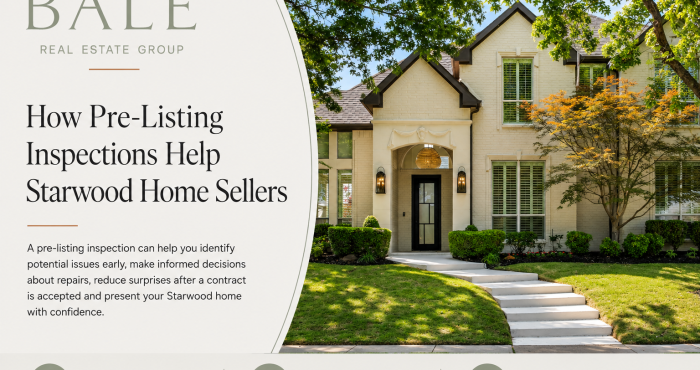
How Pre-Listing Inspections Help Starwood Home Sellers

For many homeowners, the first detailed inspection of their property occurs after a buyer has already made an offer.

At that point, the seller may suddenly be dealing with inspection findings, repair requests, contractor estimates and negotiations while important contract deadlines are approaching.

A pre-listing inspection changes the timing of that information.

Instead of waiting for the buyer’s inspector to identify potential concerns, a Starwood homeowner can learn more about the property’s condition before the home reaches the market.

That additional time can help sellers make more deliberate decisions about repairs, disclosures, pricing and preparation.

What Is a Pre-Listing Inspection?

A pre-listing inspection is a professional home inspection completed before the property is placed on the market.

The inspector generally evaluates many of the same major components that a buyer’s inspector may later examine, including areas such as:

  • Roofing and attic conditions
  • Foundation and structural observations
  • Heating and cooling systems
  • Plumbing systems
  • Electrical systems
  • Windows and doors
  • Interior and exterior components
  • Appliances included with the property
  • Drainage and grading observations
  • Pool and spa components when applicable

The objective is not to guarantee that a buyer’s inspection will identify exactly the same items.

The purpose is to give the homeowner an earlier understanding of issues that may become relevant during a future transaction.

Why This Can Be Especially Useful for Established Starwood Homes

Starwood is an established guard-gated luxury community in Frisco, and many homes may have experienced years of normal use, maintenance, improvements and system replacements.

Even a beautifully maintained luxury property can have issues that are not immediately visible to the homeowner.

Aging HVAC equipment, plumbing concerns, roof conditions, drainage issues, electrical items or pool components may not affect everyday living but could still appear on an inspection report.

Learning about those conditions before listing gives sellers more time to determine what deserves attention.

For broader information about the neighborhood, visit our Starwood community guide.

Pre-Listing Inspections Can Reduce Surprises

One of the biggest advantages of inspecting before listing is simply knowing more about the property before negotiations begin.

Without a pre-listing inspection, sellers may believe their home is in excellent condition only to receive a lengthy buyer inspection report after going under contract.

Some findings may be minor. Others may require additional evaluation or potentially significant repairs.

Discovering those concerns early does not eliminate them, but it can give sellers more control over how they respond.

Time Is Valuable When Repairs Are Needed

Once a home is under contract, inspection negotiations usually occur within defined contractual timelines.

That can force sellers to obtain contractor opinions, estimates or repairs quickly.

A pre-listing inspection gives homeowners the opportunity to investigate important items without the same immediate transaction pressure.

Sellers may be able to obtain multiple bids, select contractors carefully and make decisions based on the overall selling strategy rather than simply meeting a deadline.

Sellers Do Not Necessarily Need to Repair Everything

A pre-listing inspection is not a requirement to create a perfect home.

Inspection reports frequently contain a combination of maintenance recommendations, safety observations, aging components and items that may warrant repair or further evaluation.

The appropriate response depends on the property and the issue.

Some repairs may be relatively inexpensive and worth addressing before buyers ever see the home.

Other items may be better handled through disclosure, pricing or future negotiation rather than immediate repair.

The important advantage is that the seller has information before deciding how to proceed.

Inspection Information Can Help Prioritize Preparation

Homeowners often begin preparing for sale by focusing on visible improvements such as paint, flooring, lighting, landscaping or cosmetic renovation.

Those improvements can matter, but significant property-condition issues may ultimately become more important to a buyer than cosmetic finishes.

A pre-listing inspection can help sellers distinguish between improvements that enhance presentation and repairs that may affect the transaction itself.

This can be particularly valuable when sellers are deciding how to allocate a preparation budget.

Maintenance and Renovation Should Be Evaluated Separately

A newly renovated kitchen does not replace an aging HVAC system.

Likewise, an older kitchen does not necessarily mean a home has been poorly maintained.

Buyers may evaluate cosmetic condition and property condition separately.

A Starwood homeowner considering major updates should therefore understand whether there are maintenance items that deserve attention before spending heavily on cosmetic improvements.

For more guidance, read Should You Renovate or Sell Your Starwood Home As-Is?.

A Pre-Listing Inspection Can Support More Informed Pricing

Property condition is one of several factors that can influence a home’s competitive position.

If an inspection identifies significant deferred maintenance, that information may affect how the seller thinks about repairs or pricing.

If the home has been carefully maintained and major systems are performing well, that information may also help the seller understand the property’s strengths relative to competing homes.

Pricing should still consider comparable sales, active competition, renovations, lot characteristics, floor plan and buyer demand.

For a deeper discussion, read How to Price a Luxury Home in Starwood Frisco TX.

Early Information Can Improve Disclosure Preparation

Sellers have disclosure obligations that should be handled carefully and accurately.

A pre-listing inspection may identify conditions the homeowner was not previously aware of.

Once known, those findings can be considered as part of the disclosure process and discussed with the appropriate real estate or legal professionals when necessary.

Clear disclosure can help reduce misunderstandings later in the transaction.

Repair Documentation Can Be Valuable

When sellers choose to repair significant inspection findings before listing, keeping documentation can be useful.

Receipts, invoices, contractor reports, warranties and service records may help demonstrate what work was completed and when.

That information can also provide buyers with greater clarity about the property’s maintenance history.

A Buyer May Still Conduct Their Own Inspection

A pre-listing inspection should not be viewed as a replacement for a buyer’s independent due diligence.

Buyers may still choose to hire their own inspector after entering into a contract.

The two inspectors may also identify different items because property conditions can change and professional opinions may differ.

The benefit of the seller’s inspection is preparation—not certainty.

Pre-Listing Inspections Can Help Sellers Prepare for Negotiations

Inspection negotiations can become one of the most stressful stages of a home sale when sellers encounter issues for the first time after accepting an offer.

Knowing about potential concerns beforehand allows sellers and their Realtor to discuss possible responses before those negotiations begin.

Depending on the issue, the strategy might involve completing a repair, obtaining a specialist’s opinion, disclosing the condition, adjusting the listing strategy or being prepared to negotiate if the buyer raises the item later.

That preparation can make the transaction more manageable.

Luxury Buyers May Pay Close Attention to Major Systems

Luxury buyers often evaluate more than finishes and amenities.

A buyer considering a substantial investment in a Starwood home may also want to understand the condition of major systems and the amount of near-term maintenance the property may require.

Roof age, HVAC systems, plumbing, electrical components, windows, foundation observations and pool equipment may all influence the buyer’s assessment of the property.

A home that presents beautifully but contains significant deferred maintenance can create a different buyer reaction than one that has been consistently maintained.

Inspection Results Can Help Sellers Avoid Spending in the Wrong Places

A homeowner might initially plan to spend money replacing decorative fixtures or completing cosmetic upgrades.

If the inspection identifies a more significant concern, those priorities may change.

This is one reason it can make sense to obtain property-condition information before finalizing a large pre-sale improvement plan.

The inspection can help sellers spend money more strategically rather than simply improving the most visible areas first.

Bale Real Estate Group’s Certified Pre-Owned Home Listing Program

Bale Real Estate Group includes a professional pre-listing inspection as part of our Certified Pre-Owned Home Listing Program.

We pay for the inspection so our sellers can better understand the condition of their home before the property reaches the market.

The program is designed to help identify potential issues early, reduce avoidable surprises and provide sellers with more time to make informed decisions about repairs and preparation.

It is one component of a broader listing strategy that also considers pricing, staging, presentation, marketing and negotiation.

Learn more about why sellers hire Bale Real Estate Group.

Inspection Information Can Strengthen the Overall Listing Strategy

A home should not be marketed independently from its condition.

Inspection findings may influence preparation decisions, property descriptions, disclosure strategy and expectations about future negotiations.

When condition information is available early, those decisions can be coordinated before the listing goes live.

This helps create a more deliberate approach rather than reacting to issues after a buyer is already involved.

Pre-Listing Inspections Are About Information and Control

The primary benefit of a pre-listing inspection is not that it guarantees a problem-free transaction.

No inspection can do that.

The benefit is that sellers receive valuable information earlier in the process.

That information can provide more time to evaluate repairs, obtain professional opinions, understand costs and decide how the home’s condition should influence the overall selling strategy.

When Should a Starwood Seller Consider an Inspection?

A pre-listing inspection can be useful well before the home is actually placed on the market.

Homeowners planning to sell within the next several months may benefit from learning about property-condition issues early enough to address them thoughtfully.

It can also be useful for owners considering renovations because inspection findings may affect which improvements deserve priority.

The earlier the information is available, the more options a homeowner may have.

What Happens If the Inspection Finds a Major Issue?

A significant finding does not automatically mean the seller should cancel plans to sell or immediately complete an expensive repair.

The next step is usually to better understand the issue.

That may involve consulting an appropriate specialist, obtaining additional information, determining the likely cost of repair and considering how the condition affects the property’s market position.

The right response depends on the specific issue, the home and the seller’s objectives.

Condition Is Only One Part of a Starwood Home’s Value

Property condition matters, but it is only one element of value.

Lot location, privacy, renovations, architecture, floor plan, outdoor living, competition and buyer demand also influence how the market evaluates a Starwood property.

This is why inspection findings should be incorporated into the broader pricing and marketing strategy rather than viewed in isolation.

For additional insight, read What Makes One Starwood Home Worth More Than Another?.

Prepare Before the Buyer Begins Inspecting

Waiting until after a contract is accepted to learn about the home’s condition can limit the seller’s time and options.

A pre-listing inspection can move that discovery process earlier, when the homeowner has greater flexibility to investigate issues and decide how to proceed.

That preparation fits our broader philosophy: Clarity First, Pressure Never.

The goal is to help homeowners make informed decisions before they are operating under the deadlines and pressure of an active contract.

For broader information about buying, selling and living in the area, visit our Frisco real estate and community guide.

Considering Selling Your Starwood Home?

Gary and Linda Bale can help you evaluate your home’s condition, preparation needs, pricing and overall selling strategy before the property reaches the market.

Through our Certified Pre-Owned Home Listing Program, we provide a professional pre-listing inspection at our expense to help identify potential concerns early and reduce unnecessary surprises later in the transaction.

Meet Gary and Linda Bale and learn more about Bale Real Estate Group’s approach to representing Starwood homeowners and luxury sellers throughout Frisco.

Contact Bale Real Estate Group

Thinking about selling your Starwood home or planning ahead for a future move? Contact Gary and Linda Bale to discuss your property, timing and selling strategy.

Call or Text: (972) 469-0332
Email: info@balerealestategroup.com
Website: BaleRealEstateGroup.com

Contact Bale Real Estate Group to start a conversation about selling your Starwood home.

Posted in: Frisco, Home Selling, Luxury Living, Seller Resources, Starwood Tagged: #FriscoLuxuryHomes, #FriscoRealEstate, #HomeInspection, #LuxuryHomeSelling, #StarwoodFrisco

How to Market a Luxury Home in Starwood Frisco TX

Marketing a luxury home in Starwood requires more than placing the property in the MLS, uploading photographs and waiting for buyers to respond.

Starwood is an established guard-gated luxury community in Frisco, and its homes can vary significantly in architecture, lot characteristics, renovations, outdoor living, condition and interior design.

An effective marketing strategy should communicate what makes the individual property distinctive while positioning it appropriately against the other luxury homes a buyer may be considering.

That process begins before the listing is published.

Luxury Home Marketing Begins With Positioning

Before determining how a Starwood home should be marketed, it is important to understand what is actually being marketed.

The property should be evaluated from a prospective buyer’s perspective.

What are its strongest characteristics? What separates it from competing homes? Which features are likely to matter most to the buyer who can afford and appreciate the property?

Depending on the home, those advantages might include:

  • A particularly desirable lot
  • Greater privacy
  • Extensive renovations
  • Distinctive architecture
  • A highly functional floor plan
  • Exceptional kitchen and entertaining spaces
  • A pool and complete outdoor living environment
  • Strong natural light
  • Flexible office, guest or entertainment spaces
  • Meticulous property condition

The marketing strategy should emphasize the characteristics that create meaningful differentiation rather than simply producing a long inventory of features.

Understand the Likely Buyer

Luxury marketing becomes more effective when the property’s likely audience is understood.

A highly renovated home may appeal to buyers who want a move-in-ready property and do not want to undertake major construction.

An established home with exceptional architecture and an outstanding lot may attract a different buyer—someone willing to update interiors in exchange for characteristics that cannot easily be recreated.

The marketing message should help the right buyer understand why the property deserves consideration.

Preparation Comes Before Promotion

Strong marketing cannot completely overcome poor property preparation.

Before professional photography or buyer showings begin, sellers should evaluate whether repairs, cosmetic improvements, landscaping, decluttering or other preparation could improve the way the property is perceived.

The objective is not necessarily to renovate everything.

It is to remove avoidable distractions and allow buyers to focus on the home’s strongest characteristics.

Homeowners deciding how much work to complete before listing can read Should You Renovate or Sell Your Starwood Home As-Is?.

Professional Staging Helps Define the Luxury Experience

Staging is more than decorating.

In a luxury property, furniture placement, scale, lighting, artwork and accessories can help buyers understand how rooms function and how the home supports everyday living and entertaining.

Proper staging can also help emphasize architectural features, improve visual continuity and reduce distractions created by overly personalized furnishings.

Bale Real Estate Group provides professional home staging at our expense as part of our comprehensive listing approach.

Professional Photography Is Essential

For many buyers, the first showing happens online.

Photography therefore has an important job: it must create enough interest for a qualified buyer to want to experience the property personally.

Professional real estate photography should accurately represent the home while highlighting its architecture, scale, natural light, interior spaces and outdoor environment.

The sequence of images also matters.

A buyer should be able to move through the online presentation in a logical way and develop an understanding of how the property lives.

The Lead Image Has an Outsized Role

The first photograph may determine whether a buyer stops to explore the listing or continues scrolling.

The best lead image is not automatically the front exterior.

Depending on the property, the strongest opening photograph could feature the exterior, an exceptional kitchen, a dramatic living area or a compelling outdoor environment.

The decision should be based on which image creates the strongest immediate representation of the property’s value and character.

Tell the Story of the Property, Not Just the Specifications

Bedrooms, bathrooms, square footage and lot size are important, but buyers can find those statistics in the listing data.

Luxury marketing should also communicate how the property is experienced.

That could include the relationship between the kitchen and living areas, opportunities for entertaining, privacy of the primary suite, flexibility of additional spaces or the connection between indoor and outdoor living.

Effective property descriptions should provide useful information without relying on exaggerated language or generic luxury adjectives.

The goal is to help buyers understand what makes this particular Starwood home different.

Pricing Is Part of the Marketing Strategy

Price and marketing cannot be separated.

A beautifully presented property can still struggle if buyers believe the asking price is disconnected from its condition, location or competition.

Likewise, an exceptional property may not achieve its potential if its unique characteristics are not recognized when the pricing strategy is developed.

The asking price influences how buyers discover the property, what other homes they compare it with and the expectations they bring to a showing.

For a deeper discussion, read How to Price a Luxury Home in Starwood Frisco TX.

Digital Presentation Should Be Consistent

Buyers may encounter a listing through multiple online channels.

The property’s photographs, description, pricing and key selling points should create a consistent message wherever the home appears.

A fragmented presentation can weaken the perceived quality of the listing.

Consistency is particularly important for luxury properties because buyers often research a home extensively online before deciding whether to schedule a private showing.

Zillow Showcase Can Strengthen Online Presentation

When appropriate and available for a qualifying listing, Bale Real Estate Group may use Zillow Showcase to provide an enhanced digital presentation of the property.

The purpose is to help the listing stand out visually and give online buyers a more compelling way to explore the home.

Enhanced digital presentation should complement—not replace—strong photography, thoughtful property preparation, strategic pricing and professional representation.

Market the Lifestyle as Well as the House

Luxury buyers are not purchasing square footage alone.

They are also evaluating how a property and its location fit the way they want to live.

For a Starwood home, the broader community context can therefore be relevant to the marketing strategy.

Starwood’s established guard-gated setting, location within Frisco and access to surrounding destinations can help buyers understand the property’s overall lifestyle proposition.

Community information should remain accurate and useful rather than overwhelming the individual home’s story.

Buyers can learn more through our Starwood community guide.

Outdoor Living Deserves Its Own Marketing Attention

For many North Texas luxury properties, outdoor living represents a significant part of the home’s appeal.

A pool, covered patio, outdoor kitchen, fireplace, landscaping, yard space and privacy can create an experience that deserves more than one photograph near the end of the listing.

When outdoor living is one of the property’s defining characteristics, the photography and marketing narrative should reflect its importance.

Timing photography appropriately can also help showcase landscaping, pool areas and exterior spaces at their best.

Marketing Should Address What Buyers Cannot See in Photographs

Some valuable characteristics do not translate easily into a photograph.

Recent improvements, important system updates, maintenance history and other property information may help buyers better understand the home.

Providing relevant information can be particularly useful when a property has been carefully maintained or significantly improved.

Property Condition Can Become Part of the Value Proposition

Buyers considering a luxury home may pay close attention to the condition of major systems and components.

That is why Bale Real Estate Group offers its Certified Pre-Owned Home Listing Program.

We provide a professional pre-listing inspection at our expense so sellers can identify potential property-condition concerns before the home reaches the market.

Addressing appropriate issues in advance can help reduce surprises and allow the property to be presented with greater clarity.

Learn more about why sellers hire Bale Real Estate Group.

Launch Strategy Matters

A home’s first days on the market are important because the listing is new to the buyers and agents already watching the area.

Photography, property preparation, listing information and pricing should therefore be ready before the property is launched.

Bringing a home to market before those elements are complete can waste some of the attention associated with a new listing.

A coordinated launch gives the property an opportunity to make its strongest first impression.

Luxury Marketing Requires More Than Maximum Exposure

Exposure matters, but reaching more people is not the same as reaching the right buyer.

The objective is to place the property in front of qualified buyers while communicating why it deserves consideration relative to other luxury homes.

Effective marketing therefore combines reach with positioning.

Private Showings Must Deliver on the Online Presentation

Digital marketing creates interest. The physical property must then support the expectations created online.

Before showings, sellers should consider lighting, temperature, cleanliness, window coverings, exterior presentation and anything else that affects the buyer’s experience upon arrival.

The transition from photographs to the actual home should feel consistent.

If online marketing promises an exceptional luxury experience but the property is poorly prepared for showings, that disconnect can reduce buyer enthusiasm.

Buyer Feedback Provides Useful Market Information

Marketing should continue to evolve after the listing launches.

Showing activity, buyer feedback, repeat visits and questions can provide information about how the market is responding to the property.

New competing listings and recent sales should also be monitored.

If buyers consistently respond to the same issue, sellers should evaluate whether the property’s preparation, presentation or pricing strategy needs adjustment.

Marketing and Negotiation Are Connected

A successful marketing strategy is designed to create qualified buyer interest.

When that interest produces an offer, the seller then needs to evaluate more than the proposed purchase price.

Financing strength, contingencies, requested concessions, closing timing and other terms can affect the quality of an offer.

The ultimate objective is not simply to generate attention. It is to convert the right buyer interest into a transaction that supports the seller’s priorities.

What Makes a Starwood Home Marketable?

There is no single feature that determines whether a luxury property will attract strong buyer interest.

Lot, privacy, condition, renovations, floor plan, architecture, outdoor living, presentation, pricing and current competition all contribute to the home’s market position.

Understanding how those characteristics work together allows the marketing strategy to focus on the property’s real advantages.

For additional insight, read What Makes One Starwood Home Worth More Than Another?.

Build the Marketing Strategy Before the Home Reaches the Market

Homeowners do not need to wait until they are ready to list before discussing marketing.

An early pre-listing conversation can provide time to evaluate condition, complete appropriate repairs, make selective improvements, prepare the property and develop the pricing and marketing strategy before launch.

Our approach is Clarity First, Pressure Never. The purpose of planning early is to give homeowners better information and more options—not to pressure them into selling before they are ready.

For broader information about the area, visit our Frisco real estate and community guide.

Considering Selling Your Starwood Luxury Home?

Gary and Linda Bale can help develop a property-specific strategy that brings preparation, pricing, presentation and marketing together before your Starwood home reaches the market.

Our approach includes evaluating the property’s condition, identifying its strongest selling features, developing a competitive pricing strategy and creating a marketing presentation designed around the individual home rather than a one-size-fits-all listing plan.

Meet Gary and Linda Bale and learn more about Bale Real Estate Group’s approach to representing luxury homeowners in Starwood and throughout Frisco.

Contact Bale Real Estate Group

Thinking about selling your Starwood home or planning ahead for a future move? Contact Gary and Linda Bale to discuss your property, timing and selling strategy.

Call or Text: (972) 469-0332
Email: info@balerealestategroup.com
Website: BaleRealEstateGroup.com

Contact Bale Real Estate Group to start a conversation about selling your Starwood home.

Posted in: Frisco, Home Selling, Luxury Living, Seller Resources, Starwood Tagged: #FriscoLuxuryHomes, #FriscoRealEstate, #LuxuryHomeMarketing, #StarwoodFrisco, #StarwoodHomes

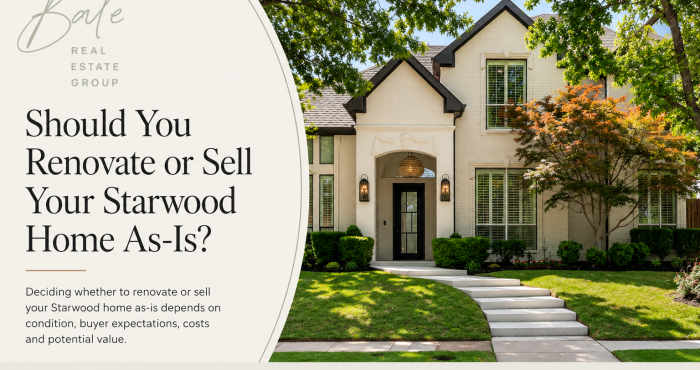
Should You Renovate or Sell Your Starwood Home As-Is?

One of the most important decisions a Starwood homeowner can face before selling is whether to renovate the property or bring it to market in its current condition.

The answer is not automatically to renovate.

Starwood is an established guard-gated luxury community in Frisco, and its homes can vary considerably in age, architecture, interior finishes, renovation history and condition. Some buyers may be willing to pay a premium for a beautifully updated property, while others may specifically prefer a home they can renovate according to their own taste.

For sellers, the real question is whether the time, cost and disruption of a proposed renovation are likely to improve the home’s competitive position enough to justify the investment.

That decision should be based on the individual property and its likely competition—not a generic remodeling checklist.

Start With the Home You Have Today

Before deciding what to change, sellers should first evaluate the property as it currently exists.

Consider the home from a prospective buyer’s perspective:

  • Does the property feel well maintained?
  • Are the major living areas visually cohesive?
  • Does the kitchen appear substantially dated?
  • Do the primary bathroom and other bathrooms meet luxury-buyer expectations?
  • Is the flooring in good condition?
  • Are paint colors highly personalized?
  • Does the lighting make the home feel current?
  • Are there visible maintenance concerns?
  • Does the outdoor environment complement the home?

The objective is not to identify everything that could possibly be improved. Almost every home could be changed in some way.

The objective is to identify the characteristics most likely to influence buyer perception and marketability.

Not Every Older Starwood Home Needs a Major Renovation

An established luxury home does not have to resemble new construction to be desirable.

Architecture, craftsmanship, lot location, mature landscaping, privacy and room proportions may all contribute to the appeal of an established Starwood property.

A well-maintained home with older finishes can still attract buyers, particularly when it is priced appropriately for its condition.

In some cases, trying to transform an established property into something it was never designed to be can result in unnecessary expense without creating a comparable increase in value.

Learn more about the community in our Starwood community guide.

Compare Your Home With What Buyers Can Purchase Today

The renovation decision should not be made in isolation.

Buyers will compare your property with other homes available at approximately the same price.

If competing Starwood homes have extensively renovated kitchens, bathrooms and interiors, an unrenovated property may need either a compelling price advantage or other characteristics that compensate for its condition.

On the other hand, if available inventory is limited or competing homes require similar updating, completing a major renovation immediately before selling may be less important.

The competitive environment helps determine whether renovation is likely to create a meaningful advantage.

Calculate the Real Cost of Renovating Before You Sell

The quoted construction price is only one component of a pre-sale renovation decision.

Sellers should also consider design expenses, materials, permits when applicable, contractor availability, possible change orders and the potential for unexpected issues once work begins.

There is also the value of time.

A project expected to take several weeks can potentially delay a listing, particularly when materials, subcontractors or inspections do not occur on schedule.

If the renovation postpones the sale, homeowners should consider whether carrying costs and changing market conditions affect the overall economics of the project.

Renovation Cost Does Not Equal Added Market Value

Spending $100,000 on a property does not automatically make that property worth $100,000 more.

Buyers determine the market value of the finished improvement through the prices they are willing to pay relative to competing homes.

Certain improvements may substantially strengthen buyer appeal. Others may improve the property without producing a comparable financial return.

This distinction is particularly important when sellers are renovating primarily for resale rather than for their own long-term enjoyment.

For a detailed discussion, read How Renovations Affect the Value of a Starwood Home.

Sometimes Selective Updates Make More Sense Than a Full Renovation

The decision does not have to be limited to two extremes: completely renovate the home or do absolutely nothing.

For some properties, selective improvements can create a meaningful change in presentation without requiring extensive construction.

Depending on the home, those improvements might include:

  • Interior painting
  • Replacing visibly dated light fixtures
  • Updating selected hardware
  • Refinishing or replacing worn flooring
  • Improving landscaping
  • Repairing damaged finishes
  • Updating selected countertops or surfaces
  • Addressing obvious deferred maintenance

A relatively focused preparation plan may allow buyers to appreciate the home’s architecture and strongest features without the seller undertaking a complete remodel.

The Kitchen Deserves Careful Evaluation

The kitchen is often one of the most expensive areas to renovate and one of the areas luxury buyers evaluate most closely.

If a kitchen is highly dated compared with competing properties, it can influence buyer perception of the entire home.

However, undertaking a complete kitchen renovation shortly before selling introduces an important question: will the future buyer share the seller’s choices?

Cabinet style, countertop material, appliances, backsplash, hardware and lighting can all be highly personal.

In some situations, pricing the property to reflect the existing kitchen may make more financial sense than completing an expensive renovation for an unknown buyer.

Bathrooms Can Affect the Perception of Overall Condition

Primary bathrooms and secondary bathrooms can also influence how updated a home feels.

Older tile, shower enclosures, countertops, plumbing fixtures and lighting may cause buyers to mentally calculate future renovation costs.

But again, the appropriate response may range from simple cosmetic improvements to a complete renovation—or no renovation at all.

The answer depends on the existing condition, likely buyer expectations and competing inventory.

Deferred Maintenance Should Be Separated From Cosmetic Updating

There is an important difference between a home that is cosmetically dated and one with unresolved property-condition concerns.

A buyer may willingly purchase an older kitchen because they want to select their own finishes. They may react very differently to concerns involving the roof, HVAC systems, plumbing, electrical components, drainage, foundation, windows or pool equipment.

Maintenance issues can create uncertainty about the property’s overall condition and can become significant negotiation points after an inspection.

That is why Bale Real Estate Group offers its Certified Pre-Owned Home Listing Program.

We provide a professional pre-listing inspection at our expense, helping sellers identify potential property-condition concerns before the home reaches the market.

This information can help homeowners distinguish between improvements that are primarily cosmetic and repairs that may deserve attention before listing.

Learn more about why sellers hire Bale Real Estate Group.

Consider the Buyer for an Unrenovated Starwood Home

An unrenovated luxury property is not necessarily a disadvantage to every buyer.

Some buyers actively seek opportunities to create a home around their own design preferences.

They may prefer purchasing a property with strong architecture, an excellent lot and an attractive floor plan at a price that allows them to complete renovations themselves.

For these buyers, a seller’s newly completed renovation could actually be less appealing if the finishes do not match their taste.

The selling strategy should therefore consider who the likely buyer is and what that buyer may value most.

A Strong Lot Can Change the Renovation Decision

Some characteristics cannot easily be changed.

Lot location, privacy, orientation and the relationship between the property and surrounding homes may create significant underlying appeal.

A buyer may be willing to renovate an interior to obtain a particularly desirable Starwood lot.

That does not mean condition becomes irrelevant, but it illustrates why every property must be evaluated individually.

Floor Plan Matters Because It Is Expensive to Change

Cosmetic finishes can usually be changed more easily than the fundamental layout of a home.

A property with an appealing floor plan may therefore remain attractive even when some finishes are dated.

Buyers may evaluate bedroom configuration, primary-suite location, kitchen connectivity, office space, entertaining areas, storage and the relationship between indoor and outdoor spaces.

If the underlying floor plan is strong, sellers should be cautious about assuming extensive cosmetic renovation is required to make the property marketable.

Do Not Renovate Solely to Chase the Highest Comparable Sale

A recently sold renovated home may establish an attractive benchmark, but sellers should understand what made that property different.

The sale price may have reflected more than new finishes.

The property could also have had a superior lot, greater privacy, stronger architecture, a better floor plan, newer systems or an exceptional outdoor environment.

Attempting to replicate its selling price through renovation alone may therefore be unrealistic.

Understanding these differences is important when determining what makes one Starwood home worth more than another.

Pricing Can Compensate for Needed Updating

A home does not have to be completely renovated to sell successfully.

It does need to be positioned appropriately relative to its condition and competition.

If buyers believe the asking price already reflects the improvements they will need to make, an unrenovated property can represent an attractive opportunity.

If the home is priced as though those renovations have already been completed, buyers may perceive a disconnect between price and condition.

This is why preparation and pricing decisions should be developed together.

For additional guidance, read How to Price a Luxury Home in Starwood Frisco TX.

Professional Staging Can Help Without Renovating

Staging cannot change cabinetry or replace an older bathroom, but it can substantially influence how buyers experience the property.

Furniture placement, lighting, accessories and visual continuity can help emphasize room size, architectural features, natural light and the functionality of the floor plan.

Bale Real Estate Group provides professional home staging at our expense as part of our approach to preparing listings for the market.

For some sellers, thoughtful staging combined with selective cosmetic improvements can be a more effective strategy than undertaking a major renovation immediately before selling.

Timing Should Be Part of the Decision

A homeowner planning to sell several years from now may approach renovations differently from someone hoping to move within the next few months.

If there is time to enjoy the improvements personally before selling, the calculation includes both lifestyle value and potential resale value.

If the sole purpose of the renovation is to sell immediately afterward, the financial return and project timeline deserve greater scrutiny.

Market conditions can also change while a major renovation is underway, which is another reason to evaluate timing before construction begins.

Get a Market Perspective Before Calling the Contractor

For homeowners considering selling, one of the most useful times to speak with a Realtor may actually be before beginning major renovation work.

A property-specific market analysis can help identify which features are creating a competitive disadvantage, which improvements may strengthen the home and which projects may have limited influence on resale.

That information can help sellers allocate their preparation budget more deliberately.

Our approach is Clarity First, Pressure Never. A pre-listing conversation does not mean a homeowner needs to sell immediately. It is an opportunity to understand the property and make better decisions before investing substantial money.

So, Should You Renovate or Sell Your Starwood Home As-Is?

The answer depends on the home.

A property with significant deferred maintenance may require attention before listing. Another home may benefit from a carefully selected group of cosmetic improvements. A third may be better positioned and priced in its existing condition so the future buyer can complete renovations according to their own preferences.

The right strategy should consider renovation cost, potential market value, time, current competition, the home’s underlying strengths and the expectations of likely Starwood buyers.

For broader information about the area, visit our Frisco real estate and community guide.

Considering Selling Your Starwood Home?

Before committing to a major renovation, Gary and Linda Bale can help you evaluate how your home currently compares with the Starwood luxury market and which improvements may—or may not—strengthen its position.

Meet Gary and Linda Bale and learn more about Bale Real Estate Group’s approach to preparing and representing luxury homes in Starwood and throughout Frisco.

Posted in: Frisco, Home Selling, Seller Resources, Starwood Tagged: #FriscoLuxuryHomes, #FriscoRealEstate, #LuxuryHomeSelling, #StarwoodFrisco, #StarwoodHomes

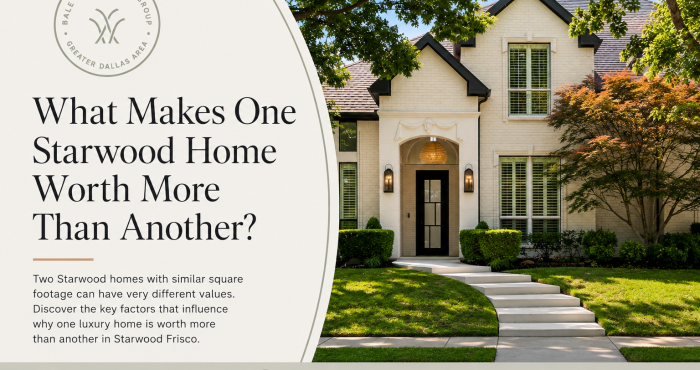
What Makes One Starwood Home Worth More Than Another?

Two homes in Starwood can appear similar on paper and still have significantly different market values.

They may have comparable square footage, the same number of bedrooms and bathrooms, and even be located within the same section of the community. Yet buyers may respond very differently to each property.

That is because luxury-home value is influenced by much more than basic statistics.

Starwood is an established guard-gated luxury community in Frisco where individual homes can differ substantially in lot location, privacy, architecture, renovations, condition, floor-plan functionality, outdoor living and overall presentation.

Understanding those differences is important for homeowners trying to determine what their property may be worth and how it should eventually be positioned for sale.

Square Footage Is Only One Piece of the Value Equation

Square footage is important, but buyers do not necessarily value every square foot equally.

A larger home with inefficient room placement, limited natural light or dated interiors may not command the same buyer response as a smaller home with an exceptional layout, strong updates and a desirable lot.

Luxury buyers typically evaluate both the amount of space and the quality of that space.

They may consider how rooms connect, whether the home offers desirable entertaining areas, how the kitchen functions, where the primary suite is located, whether there are appropriate work-from-home spaces and how comfortably the property accommodates guests and everyday living.

This is why price per square foot should be treated as a reference point rather than a complete valuation method.

Lot Location Can Create Meaningful Differences in Value

The land beneath and around the home can influence value just as much as the improvements built on it.

Within Starwood, buyers may place different values on properties depending on lot size, orientation, surrounding homes, traffic exposure, backyard configuration and the sense of privacy the property provides.

A home positioned on a particularly appealing lot may generate stronger buyer interest even when the house itself is similar to another property elsewhere in the community.

That lot advantage can be difficult to replicate and may therefore influence both marketability and value.

Privacy Matters to Many Luxury Buyers

Privacy can be a significant consideration in luxury real estate.

Buyers may evaluate how closely neighboring homes are positioned, what can be seen from primary living spaces, whether outdoor areas feel exposed and whether landscaping or lot placement creates separation from surrounding properties.

A backyard that feels private may be perceived differently from one with greater visual exposure, even when both properties have similar pools and outdoor features.

For a deeper look at this issue, homeowners can review our article on lot location and privacy in Starwood.

Renovation Quality Can Influence Buyer Perception

Renovations can strengthen a home’s competitive position, but the fact that a property has been remodeled does not automatically mean buyers will assign substantial additional value.

The quality, consistency and relevance of the renovation matter.

Luxury buyers may evaluate cabinetry, countertops, flooring, lighting, appliances, bathrooms, hardware, millwork and how well newer finishes integrate with the home’s architecture.

A cohesive renovation using materials appropriate for the property may create a stronger reaction than improvements that feel piecemeal or overly personalized.

Homeowners considering improvements before selling can read How Renovations Affect the Value of a Starwood Home.

Condition and Renovation Are Not the Same Thing

A home can be beautifully renovated and still have deferred maintenance.

Another home may have older finishes but be exceptionally well maintained.

Buyers may evaluate both cosmetic appeal and the condition of major systems and components.

Concerns involving roofing, HVAC equipment, plumbing, electrical systems, windows, drainage, foundation conditions, pool equipment or other major components can affect how buyers perceive risk.

Those issues may also become important during inspection negotiations after a contract is accepted.

Bale Real Estate Group addresses this through our Certified Pre-Owned Home Listing Program, which includes a professional pre-listing inspection paid for by Bale Real Estate Group.

The goal is to help sellers identify potential concerns before the home enters the market so they can make more informed decisions about repairs, disclosures and preparation.

Learn more about why sellers hire Bale Real Estate Group.

Floor-Plan Functionality Can Change the Buyer’s Experience

Two homes with the same square footage can feel dramatically different when buyers walk through them.

One may have an open, intuitive flow between the kitchen, living areas and outdoor spaces. Another may have rooms that feel disconnected or spaces that are difficult to use for today’s lifestyles.

Buyers may also consider bedroom placement, guest accommodations, office space, media or game rooms, storage and how effectively the home supports both daily life and entertaining.

A floor plan that appeals to a broader group of buyers can strengthen demand and therefore influence value.

Architecture Can Distinguish One Starwood Home From Another

Architectural character can be difficult to quantify but important to buyer perception.

Ceiling heights, window placement, natural light, exterior proportions, room scale, architectural details and the overall design of the home can affect how memorable a property feels.

Some homes create an immediate emotional response that cannot be explained solely through square footage or bedroom count.

That emotional appeal can influence how strongly buyers compete for a property.

The Kitchen Often Plays an Outsized Role

Luxury buyers frequently spend significant time evaluating the kitchen.

They may consider cabinetry, appliances, countertops, storage, island configuration, lighting, connectivity to living areas and whether the kitchen feels appropriate for the scale and quality of the home.

A well-designed kitchen can become one of the property’s strongest selling features.

A dated or poorly functioning kitchen can have the opposite effect because buyers may immediately begin estimating the cost and disruption associated with renovation.

Primary Suites and Bathrooms Can Influence Perceived Luxury

The primary suite is another area where buyers often form strong impressions.

Bedroom size, privacy, natural light, closet space and the quality of the primary bathroom may all affect the perceived level of luxury.

A recently updated bathroom with thoughtful materials and a functional layout may strengthen the home’s competitive position.

Conversely, a primary suite requiring significant modernization may become a factor buyers use when comparing the home with alternatives.

Pools and Outdoor Living Can Separate Competing Homes

Outdoor living is an important component of many Starwood properties.

Buyers may evaluate not simply whether a home has a pool, but the quality of the entire outdoor environment.

That may include the pool’s design and condition, covered patios, outdoor kitchens, fireplaces, landscaping, yard space, shade, privacy and the relationship between indoor and outdoor entertaining areas.

A thoughtfully designed outdoor environment can create meaningful lifestyle appeal.

However, outdoor features should still be evaluated in the context of the entire property. An expensive pool or outdoor kitchen does not automatically produce a dollar-for-dollar increase in market value.

Natural Light and Interior Presentation Can Affect Buyer Response

Some value differences are subtle until buyers physically experience the home.

Natural light, sight lines, ceiling heights, room proportions and the way furniture is arranged can influence whether a property feels bright, spacious and welcoming.

This is one reason professional staging can matter when preparing a luxury home for sale.

Bale Real Estate Group provides professional staging at our expense to help present our listings in a way that highlights their strongest features and improves the overall buyer experience.

Garage Configuration and Functional Amenities Matter

Luxury buyers may also place value on features that receive less attention in basic property descriptions.

Garage capacity, storage, workshop potential, additional parking, home offices, exercise rooms, wine storage, media rooms and flexible living areas can influence buyer preferences.

The importance of any individual feature depends on the buyer, but together these elements can help distinguish one property from another.

Updates That Reduce Future Work Can Be Valuable to Buyers

Some buyers actively seek homes they can move into without immediately beginning major projects.

For those buyers, a property with recently completed updates, well-maintained systems and cohesive finishes may offer greater appeal than a home requiring significant work.

Other buyers may prefer an unrenovated home they can customize themselves.

Understanding which type of buyer is most likely to be attracted to the property can help determine how the home should be positioned and priced.

Current Competition Influences Relative Value

A home’s value is not determined in isolation.

Buyers compare available properties against one another.

If several competing Starwood homes are on the market at the same time, differences in condition, renovations, lots, floor plans and pricing can directly affect buyer decisions.

A home that looks compelling relative to the competition may generate stronger interest. A property that appears expensive for its condition may be overlooked even if its asking price seemed reasonable based on older comparable sales.

Recently Sold Homes Provide Important Evidence

Closed sales help show what buyers have actually paid for properties with similar characteristics.

But the most useful comparable sale is not necessarily the closest home or the one with the most similar square footage.

The better comparison is often the property that a buyer would realistically have considered as an alternative.

This is why comparable sales should be adjusted mentally for differences in lot, renovation level, condition, architecture, floor plan and overall appeal.

Buyer Demand Can Change the Value Equation

The same property can face different levels of demand depending on the broader luxury market.

Inventory, financing conditions, relocation activity, economic confidence and the number of qualified buyers actively searching in Frisco can all influence competition.

A feature that creates a significant premium during a low-inventory environment may generate less pricing power when buyers have many competing homes to choose from.

Current market conditions should therefore be considered alongside property-specific characteristics.

Automated Valuations Cannot See These Differences

Online home-value estimates can provide a general reference, but they cannot fully evaluate many of the characteristics that make one Starwood home more valuable than another.

An automated model may identify square footage, bedroom count and previous sales history.

It may not accurately account for renovation quality, privacy, outdoor living, architectural character, floor-plan functionality, maintenance condition or the emotional response buyers have when entering the property.

For luxury homes, those differences can be meaningful.

Why a Property-Specific Valuation Matters

Determining the likely market value of a Starwood home should begin with both data and a physical evaluation of the property.

The process should consider recent comparable sales, current listings and the individual characteristics that make the home stronger or weaker relative to those alternatives.

That analysis helps establish a realistic value range and provides the foundation for an effective pricing strategy.

For more information about pricing, read How to Price a Luxury Home in Starwood Frisco TX.

Small Differences Can Create Large Differences in Buyer Perception

Luxury buyers often make decisions based on the entire experience of the property.

A better lot, more privacy, stronger renovation, superior floor plan or exceptional outdoor environment may create a meaningful advantage even when those differences are difficult to summarize in a spreadsheet.

Conversely, deferred maintenance, dated finishes or a less desirable property characteristic can affect demand even when the home compares favorably in size.

The key is understanding which differences matter most to today’s likely buyers.

Understanding What Your Starwood Home Is Worth

Every Starwood property should be evaluated individually.

Gary and Linda Bale can help homeowners assess their property’s competitive position by considering recent sales, current inventory, lot characteristics, renovations, condition, floor plan, outdoor living, architecture and buyer demand.

For homeowners who are months or even years away from selling, that information can also help guide decisions about renovations, repairs and future preparation.

Our approach is Clarity First, Pressure Never. The goal is to give homeowners a realistic understanding of where their property fits within the Starwood luxury market before they make important selling or improvement decisions.

For broader community information, visit our Starwood community guide or our Frisco real estate and community guide.

Considering Selling Your Starwood Home?

Before choosing a listing price or beginning major improvements, it can be valuable to understand which characteristics of your property are likely to influence buyer perception most.

Meet Gary and Linda Bale and learn more about Bale Real Estate Group’s approach to representing luxury homeowners in Starwood and throughout Frisco.

Posted in: Frisco, Home Selling, Seller Resources, Starwood Tagged: #FriscoLuxuryHomes, #FriscoRealEstate, #LuxuryHomeValues, #StarwoodFrisco, #StarwoodHomes

How to Price a Luxury Home in Starwood Frisco TX

Pricing a luxury home in Starwood is not as simple as multiplying the home’s square footage by an average neighborhood price per square foot.

Starwood is an established guard-gated luxury community in Frisco, and individual properties can differ considerably in lot location, architecture, age, renovations, interior finish, outdoor living, privacy, condition, floor plan and overall buyer appeal.

Those differences can create meaningful variations in value—even between homes located relatively close to one another.

For a Starwood homeowner preparing to sell, the objective should not automatically be to choose the highest possible asking price. The objective is to establish a price and positioning strategy that reflects the property’s individual characteristics, current competition and the behavior of qualified luxury buyers.

That requires looking well beyond a neighborhood average.

Why Pricing a Starwood Home Requires Property-Specific Analysis

In neighborhoods where homes are highly similar, comparable sales can sometimes provide a relatively narrow range of value.

Luxury communities are different.

Two Starwood homes with similar square footage may not necessarily compete at the same price if one has been extensively renovated while the other retains older finishes. The same applies when one property has a particularly desirable lot, greater privacy, a superior outdoor environment or a floor plan that aligns more closely with current buyer preferences.

Pricing therefore begins by understanding exactly where the individual home fits within the Starwood market.

Homeowners who want a broader understanding of the neighborhood can visit our Starwood community guide.

Recent Comparable Sales Are the Starting Point, Not the Finish Line

Recent closed sales provide important evidence of what buyers have actually been willing to pay.

But selecting comparable properties requires more than finding homes in Starwood with similar square footage.

A useful comparable-sale analysis should consider characteristics such as:

  • Location within the community
  • Lot size and lot characteristics
  • Home size and functional living space
  • Architectural style
  • Age and construction quality
  • Interior condition
  • Extent and quality of renovations
  • Floor-plan functionality
  • Pool and outdoor living features
  • Privacy and surrounding property influences
  • Garage configuration and other meaningful amenities

The strongest comparable is not necessarily the home geographically closest to the property being priced. It is the property a prospective buyer would reasonably view as an alternative.

Active Competition Can Be Just as Important as Past Sales

Closed sales help establish historical market evidence. Active listings show sellers what buyers can choose from today.

This distinction matters.

A homeowner may find a strong comparable sale supporting a particular value, but if several competing homes have subsequently entered the market with better updates, stronger lots or more attractive pricing, buyers will evaluate the property against those alternatives.

Luxury buyers generally do not evaluate a home in isolation. They compare the entire opportunity.

That makes current competition an essential component of the pricing conversation.

Price Per Square Foot Has Limitations in Starwood

Price per square foot can be a useful reference point, but it should not become the primary method for valuing an individual luxury home.

A square foot is not equally valuable in every property.

Buyers evaluate how that space is configured, the quality of the home, its condition, location, architectural appeal and the lifestyle the property provides.

A smaller, beautifully renovated home with an exceptional lot and highly functional floor plan could potentially command a higher price per square foot than a larger property requiring significant updating.

For that reason, neighborhood price-per-square-foot statistics should provide context rather than dictate the listing price.

Lot Location and Privacy Can Influence Value

Not every lot within a luxury community provides the same experience.

Lot orientation, size, privacy, views, surrounding properties, traffic exposure and the relationship between the home and neighboring residences can influence buyer perception.

A particularly desirable lot may create value that cannot be captured simply by comparing interior square footage.

Conversely, a property with a location characteristic that some buyers perceive as less desirable may need to be positioned differently, even if the home itself is exceptional.

The key is determining how buyers are likely to compare the complete property—not merely the structure.

Renovations Can Affect the Pricing Range

Starwood includes established luxury homes with varying levels of renovation and modernization.

A thoughtfully renovated property may compete differently from a similar home with predominantly original finishes.

However, renovation cost should never simply be added to a home’s previous value.

Buyers determine what they are willing to pay for the finished property. The market may reward certain improvements strongly while assigning considerably less value to others.

Quality also matters. A renovation using materials and craftsmanship appropriate for a luxury property may influence buyers differently than cosmetic work that appears inconsistent with the rest of the home.

For a deeper discussion of this issue, read How Renovations Affect the Value of a Starwood Home.

Condition Can Influence Both Price and Negotiating Leverage

Condition and renovation are related, but they are not the same thing.

A home can have beautiful finishes while still having deferred maintenance. Another property can have older finishes but be exceptionally well maintained.

Luxury buyers may evaluate both.

Visible maintenance concerns can affect initial buyer perception, while significant property-condition issues discovered during inspections can affect negotiations after a contract has been executed.

This is one reason Bale Real Estate Group offers its Certified Pre-Owned Home Listing Program.

We provide a professional pre-listing inspection at our expense so sellers can better understand potential property-condition issues before the home reaches the market.

Identifying concerns in advance can help a homeowner decide what to repair, what may need further evaluation and how the property’s condition should factor into the overall selling strategy.

Learn more about why sellers hire Bale Real Estate Group.

Floor Plan and Functionality Matter to Luxury Buyers

Square footage tells buyers how much space a home contains. It does not tell them how effectively that space works.

Luxury buyers may consider bedroom configuration, primary-suite location, home-office options, entertaining spaces, kitchen connectivity, storage, game or media rooms, guest accommodations and the relationship between indoor and outdoor areas.

A floor plan that aligns well with current buyer expectations may create stronger demand than another home with comparable—or even greater—square footage.

These differences should be considered when selecting comparable properties and establishing the pricing range.

Pools and Outdoor Living Can Change the Comparison

In North Texas luxury real estate, the backyard can represent a significant component of the overall property experience.

A pool alone does not establish a specific amount of additional value.

Buyers may evaluate the pool’s design, condition and age along with covered living areas, landscaping, outdoor kitchens, fireplaces, yard space, privacy and how effectively the outdoor environment connects with the interior.

An exceptional outdoor environment may help distinguish one Starwood home from another, while older outdoor improvements requiring substantial work may be viewed differently.

Architecture and Interior Presentation Influence Buyer Perception

Luxury real estate contains an emotional component that cannot always be captured by a spreadsheet.

Buyers may respond differently to architectural styles, ceiling heights, natural light, room proportions, interior finishes and the overall visual continuity of a property.

Presentation can therefore influence how buyers perceive value once they enter the home.

This is why pricing and property preparation should be considered together rather than as completely separate decisions.

Bale Real Estate Group provides professional home staging at our expense to help position our listings for the market. The goal is not to disguise a home’s characteristics. It is to present the property so buyers can more clearly appreciate its strongest features.

The Highest Listing Price Is Not Necessarily the Best Pricing Strategy

Homeowners understandably want to maximize their selling price.

But maximizing value and choosing the highest initial asking price are not necessarily the same strategy.

An asking price that substantially exceeds what buyers believe competing properties justify can reduce urgency and make the home easier to eliminate from consideration.

If a property remains on the market while better-positioned homes sell, buyers may begin questioning why it has not sold.

Price reductions can eventually restore competitiveness, but they do not recreate the property’s first days on the market.

That initial launch period deserves careful consideration when developing the pricing strategy.

Underpricing a Luxury Home Also Carries Risk

Strategic pricing does not mean automatically pricing below market value.

A luxury property has characteristics that may be difficult to replicate, and sellers should understand those advantages before establishing the asking price.

Pricing too aggressively downward without a clear strategic reason can leave value on the table.

The objective is to identify a defensible range and then determine where within that range the property should be positioned based on competition, market conditions and the seller’s objectives.

Online Search Ranges Can Affect Buyer Exposure

Pricing also has a practical digital component.

Buyers frequently search for homes using price ranges. A listing price can therefore affect which searches include the property and which exclude it.

This does not mean sellers should choose a price solely to fit an online search threshold. It does mean the relationship between pricing and buyer discovery should be considered as part of the overall launch strategy.

Appraisal Considerations Should Not Be Ignored

When a buyer finances a luxury-home purchase, the lender may require an appraisal.

An accepted contract price and an appraised value are two different things.

Unique luxury properties can sometimes present appraisal challenges because the most relevant comparable sales may differ in size, condition, location or features.

A strong pricing strategy should therefore consider not only what a buyer might offer, but also the available market evidence supporting the property’s value.

This becomes particularly important when the asking or contract price substantially exceeds recent comparable sales.

Buyer Demand Changes With the Market

A home’s characteristics do not change simply because market conditions change, but the number of buyers competing for that property can.

Interest rates, luxury inventory, economic conditions, relocation activity and buyer confidence can all affect demand.

A pricing strategy that worked during a period of extremely limited inventory may not produce the same result when buyers have more choices.

This is why current market behavior matters more than relying on what a neighbor’s home sold for several years ago.

Seller Timing and Objectives Should Be Part of the Strategy

There is not always one mathematically perfect listing price.

A homeowner who needs to complete a sale within a specific period may choose a different positioning strategy than a seller who has considerable flexibility and is prepared to test the upper portion of a reasonable market range.

The important point is that the seller understands the tradeoffs.

Pricing decisions should be deliberate and connected to the homeowner’s objectives rather than based on an arbitrary number or an automated valuation.

Automated Home Values Have Significant Limitations

Online home-value estimates can be useful as an initial reference, but they cannot physically walk through a Starwood home.

An automated model may recognize square footage, bedrooms, bathrooms and historical sales. It may have far more difficulty understanding the quality of a renovation, the condition of the home, privacy, architectural appeal, the functionality of the floor plan or how the property compares visually with its current competition.

For an individual luxury property, those details can matter considerably.

A pricing recommendation should therefore combine market data with a property-specific evaluation.

Pricing and Marketing Need to Work Together

Even a well-priced luxury home can underperform if buyers do not understand what makes the property special.

Photography, staging, listing presentation, property descriptions, digital exposure and the overall marketing strategy should reinforce the value represented by the asking price.

The goal is to create consistency between what buyers see online, what they experience when they visit the property and what the market data suggests the home is worth.

Bale Real Estate Group also uses enhanced digital marketing opportunities, including Zillow Showcase when appropriate, to help qualifying listings receive a more compelling online presentation.

Monitor the Market After the Home Is Listed

Pricing does not end when a listing goes live.

Buyer activity provides additional information.

Showings, repeat visits, buyer feedback, competing listings, new contracts and newly closed sales can all provide insight into how the market is responding.

If the response differs substantially from expectations, sellers should evaluate the evidence rather than simply waiting and hoping the market changes.

A disciplined listing strategy includes monitoring the property’s position throughout the selling process.

How Should You Price Your Starwood Home?

The answer begins with the individual property.

We evaluate relevant sales, current competition, condition, renovations, lot characteristics, floor plan, outdoor living, architectural appeal and current buyer demand before recommending a pricing strategy.

For homeowners who are not ready to sell immediately, an early conversation can still be useful. Understanding how the market may view the home can help guide future renovation, repair and preparation decisions.

Our approach is Clarity First, Pressure Never. The objective is to give Starwood homeowners the information needed to make an informed decision about their property and timing.

For broader information about buying, selling and living in Frisco, visit our Frisco real estate and community guide.

Considering Selling Your Starwood Home?

Gary and Linda Bale can help you evaluate where your property fits within the current Starwood luxury market and develop a pricing, preparation and marketing strategy specific to your home.

The process begins by understanding the property—not by selecting a price before its individual strengths and competitive position have been evaluated.

Meet Gary and Linda Bale and learn more about Bale Real Estate Group’s approach to representing luxury homeowners in Starwood and throughout Frisco.

Posted in: Frisco, Home Selling, Seller Resources, Starwood Tagged: #FriscoLuxuryHomes, #FriscoRealEstate, #LuxuryHomeSelling, #StarwoodFrisco, #StarwoodHomes

How Lot Location and Privacy Affect Starwood Home Values

A luxury home can look exceptional during a showing and still contain conditions that deserve careful evaluation before closing.

Starwood is an established guard-gated Frisco luxury community with custom homes that can differ significantly in age, renovation history, construction, pools, outdoor living, landscaping, roofing, HVAC systems, windows, drainage, and ongoing maintenance.

A professional home inspection helps buyers move beyond appearance and better understand the visible and accessible condition of a property before important contractual deadlines expire.

Gary and Linda Bale of Bale Real Estate Group help Starwood buyers use inspection information as part of the complete purchase analysis—not simply as a checklist of repairs.

Start With the Starwood Homes Available Today

Every Starwood property should be evaluated individually because condition, renovations, systems, pools, and maintenance can differ substantially from one home to another.

No Results Found.

When comparing available homes, buyers should consider:

  • Property age
  • Renovation history
  • Roof condition
  • HVAC systems
  • Foundation observations
  • Windows
  • Plumbing
  • Electrical components
  • Drainage
  • Pool and spa
  • Exterior condition
  • Deferred maintenance

The objective is to understand the complete property rather than assuming that a higher price or newer interior means fewer potential concerns.

Why Inspections Matter in an Established Luxury Community

Luxury homes can contain more systems, equipment, square footage, exterior components, and specialized features than a typical property.

Depending on the home, an inspection may provide information about:

  • Structural components
  • Roofing
  • Heating and cooling systems
  • Plumbing
  • Electrical components
  • Windows and doors
  • Attic conditions
  • Exterior materials
  • Drainage
  • Built-in appliances

Inspection findings may also identify areas where evaluation by an appropriate specialist would be useful.

Updated Starwood Homes Still Need Inspections

New countertops, flooring, paint, lighting, cabinetry, and bathroom finishes do not establish the condition of the underlying home.

A beautifully renovated property may still contain older:

  • HVAC systems
  • Roofing
  • Windows
  • Water heaters
  • Plumbing components
  • Electrical components
  • Pool equipment

Buyers should distinguish between cosmetic renovation and improvements to major property systems.

Roof Condition Deserves Careful Attention

Luxury homes can have large and architecturally complex roof systems.

Buyers may want to understand:

  • Visible roof condition
  • Approximate age when known
  • Previous repairs when known
  • Roofing materials
  • Flashing
  • Drainage components
  • Visible signs of moisture intrusion

When an inspection identifies concerns, further evaluation by a qualified roofing professional may be appropriate.

Multiple HVAC Systems Can Represent Significant Future Expense

Larger Starwood homes may have multiple heating and cooling systems.

Buyers should understand:

  • Number of systems
  • Approximate ages
  • Visible condition
  • Operation at the time of inspection
  • Maintenance history when available

Several aging systems can create a substantially different ownership-cost profile from a home with newer or recently replaced equipment.

Foundation and Structural Observations Matter

Buyers should pay attention to observations involving the home’s structure and foundation.

Potential observations may involve:

  • Visible movement
  • Cracking
  • Door or window operation
  • Floor conditions
  • Exterior observations
  • Drainage around the structure

A general home inspector can identify visible conditions within the scope of the inspection, while specialized structural questions may require evaluation by an appropriate professional.

Drainage Should Not Be Overlooked

Drainage can affect foundations, landscaping, pools, retaining walls, patios, and long-term property maintenance.

Buyers may want to understand:

  • Property grading
  • Downspout discharge
  • Standing water
  • Drainage systems
  • Retaining walls
  • Erosion
  • Water movement near the foundation

Mature landscaping and extensive hardscaping can make drainage evaluation particularly important.

Windows Can Represent a Significant Future Investment

A large luxury home may contain many windows, making their condition an important ownership consideration.

Inspection observations may include:

  • Operation
  • Visible damage
  • Failed seals
  • Moisture concerns
  • Exterior condition
  • General installation observations

Extensive window repair or replacement across a large home can become a meaningful future expense.

Evaluate Plumbing and Water-Related Components

Plumbing conditions can affect both immediate repairs and long-term ownership costs.

Depending on the property, buyers may want information about:

  • Visible supply and drain components
  • Water heaters
  • Fixtures
  • Water pressure
  • Visible leaks
  • Drain performance
  • Previous modifications

Inspection findings may lead to further evaluation when a condition requires specialized expertise.

Electrical Systems Should Be Evaluated

Custom homes and renovated properties may contain electrical modifications completed at different times.

An inspection may provide information regarding visible and accessible:

  • Electrical panels
  • Outlets
  • Switches
  • Fixtures
  • Safety devices
  • Visible wiring conditions

Concerns identified during the inspection may warrant evaluation by a qualified electrician.

Consider Additional Evaluation of the Pool and Spa

A pool can be one of the most important lifestyle features of a Starwood property and also one of its more significant maintenance systems.

Buyers may want to understand:

  • Pool surface condition
  • Tile and coping
  • Decking
  • Pumps
  • Filters
  • Heaters
  • Spa operation
  • Automation
  • Visible leaks or concerns

Depending on the property and inspection findings, evaluation by a qualified pool professional may provide useful additional information.

Inspect Previous Renovations Carefully

Starwood homes may have undergone substantial renovations during previous ownership.

Buyers should look beyond the appearance of the finished work and consider:

  • Workmanship
  • Structural modifications
  • Electrical changes
  • Plumbing changes
  • Window replacements
  • Room additions
  • Outdoor additions
  • Consistency with the original architecture

When a renovation raises questions beyond the scope of a general inspection, additional professional evaluation may be appropriate.

Know When Additional Specialists May Be Appropriate

A general inspection is an important starting point, but some conditions require specialized expertise.

Depending on findings, buyers may consider appropriate professionals for:

  • Roofing
  • HVAC
  • Foundation or structural concerns
  • Plumbing
  • Electrical systems
  • Pools
  • Drainage
  • Windows
  • General contracting

The appropriate specialists depend on the specific property and conditions identified during due diligence.

Inspection Findings Help Clarify the Total Purchase

Inspection findings can help buyers better understand what ownership may require after closing.

Potential considerations may include:

  • Immediate repairs
  • Deferred maintenance
  • Near-term replacements
  • Longer-term capital expenses
  • Specialist evaluations
  • Renovation priorities

The purpose is not simply to create a repair list. The information can help buyers determine whether the property’s overall condition remains consistent with their expectations, purchase price, and financial plans.

Inspection Information Can Affect Negotiation Strategy

Inspection findings may become relevant to a buyer’s decisions during the contractual period.

The appropriate strategy can depend on:

  • Contract terms
  • Property condition
  • Materiality of the findings
  • Market conditions
  • Seller circumstances when known
  • Buyer priorities
  • Available alternatives

Learn More About Offer Strategy

Learn More About the Home Inspection Process

Understanding what an inspection can and cannot tell you helps establish realistic expectations before the inspection occurs.

Learn More About Home Inspections

Inspection Is One Part of the Complete Starwood Buying Decision

Buyers should combine property due diligence with an evaluation of Starwood’s community environment, location, lifestyle, commute, shopping, dining, recreation, and access to the broader Frisco and North Dallas area.

Watch Linda Bale: Why Are So Many People Moving to Frisco, Texas?

How Gary & Linda Bale Help Starwood Buyers Through Inspections

Gary and Linda Bale help buyers organize the inspection process and place findings within the broader purchasing decision.

Their buyer strategy can include:

  • Inspection coordination
  • Reviewing property-specific concerns
  • Identifying areas requiring specialist evaluation
  • Comparing findings with property pricing
  • Considering future ownership costs
  • Evaluating negotiation strategy
  • Tracking contractual deadlines
  • Coordinating through closing

Gary and Linda are ranked among the Top 1% of North Texas Realtors and have helped clients complete more than 70 successful transactions representing over $50 million in residential real estate volume during the past 36 months.

Meet Gary & Linda Bale

Read Client Testimonials

Frequently Asked Questions About Starwood Luxury Home Inspections

Should I inspect an updated Starwood home?

Yes. Cosmetic renovations do not establish the condition of roofing, HVAC systems, plumbing, electrical components, foundations, drainage, windows, pools, or other major systems.

Does a general inspection cover everything?

No. A general inspection has a defined scope. Findings may indicate that additional evaluation by qualified specialists is appropriate.

Should the roof receive additional evaluation?

When inspection findings raise concerns or more detailed information is needed, evaluation by an appropriate roofing professional may be useful.

Why are HVAC systems important in Starwood?

Larger luxury homes may contain multiple HVAC systems. Several aging units can represent meaningful future replacement costs.

Should the pool receive additional evaluation?

Depending on the property and inspection findings, a qualified pool professional may provide additional information about equipment, surfaces, heaters, spas, automation, and other components.

Why does drainage matter?

Drainage can affect foundations, landscaping, pools, patios, retaining walls, and long-term property maintenance.

Should windows be evaluated?

Yes. A large luxury home may contain many windows, making widespread repair or replacement a potentially significant future expense.

What if the inspector identifies a foundation concern?

Depending on the finding, additional evaluation by an appropriate qualified professional may be warranted.

Should previous renovations be inspected?

Yes. Buyers should consider visible workmanship and conditions involving previous structural, electrical, plumbing, window, interior, and exterior modifications.

Can inspection findings affect negotiations?

They can. The appropriate response depends on the contract, property condition, significance of the findings, market conditions, seller circumstances when known, and buyer priorities.

Is the inspection only about negotiating repairs?

No. Inspection information can also help buyers understand the property, anticipate future maintenance, prioritize improvements, and decide whether the home remains the right purchase.

Can Gary and Linda help coordinate additional specialists?

Yes. Bale Real Estate Group can help buyers connect with appropriate professionals when additional property-specific evaluation is needed.

Helpful Resources for Starwood Buyers

Home Inspections

Buyer Services

Offer Strategy

Mortgage Pre-Approval

Relocating to North Dallas

Meet Gary & Linda Bale

Client Testimonials

Considering Buying a Luxury Home in Starwood?

A home inspection is one of the most important opportunities to better understand a Starwood property before completing the purchase.

Gary and Linda Bale can help you evaluate the complete opportunity, including property pricing, comparable sales, renovations, visible condition, inspection findings, specialist evaluations, major systems, pools, outdoor living, lot characteristics, future ownership costs, negotiation strategy, and contractual deadlines.

Their goal is to help you understand the property as clearly as possible before you make a major purchasing decision.

Contact Gary & Linda Bale


Gary Bale & Linda Bale
Bale Real Estate Group

Phone: 972-469-0332
Email: info@BaleRealEstateGroup.com

Schedule a Starwood Buyer Consultation

Posted in: Buyer Resources, Frisco, Home Values, Luxury Living, Seller Resources, Starwood Tagged: #BaleRealEstateGroup, #FriscoLuxuryHomes, #LuxuryRealEstate, #StarwoodFrisco, #StarwoodHomeValues

How Home Inspections Protect Luxury Buyers in Starwood Frisco TX


Lorem ipsum dolor sit amet, consectetur adipiscing elit. Ut elit tellus, luctus nec ullamcorper mattis, pulvinar dapibus leo.

A luxury home can look exceptional during a showing and still contain conditions that deserve careful evaluation before closing.

Starwood is an established guard-gated Frisco luxury community with custom homes that can differ significantly in age, renovation history, construction, pools, outdoor living, landscaping, roofing, HVAC systems, windows, drainage, and ongoing maintenance.

A professional home inspection helps buyers move beyond appearance and better understand the visible and accessible condition of a property before important contractual deadlines expire.

Gary and Linda Bale of Bale Real Estate Group help Starwood buyers use inspection information as part of the complete purchase analysis—not simply as a checklist of repairs.

Start With the Starwood Homes Available Today

Every Starwood property should be evaluated individually because condition, renovations, systems, pools, and maintenance can differ substantially from one home to another.

No Results Found.

When comparing available homes, buyers should consider:

  • Property age
  • Renovation history
  • Roof condition
  • HVAC systems
  • Foundation observations
  • Windows
  • Plumbing
  • Electrical components
  • Drainage
  • Pool and spa
  • Exterior condition
  • Deferred maintenance

The objective is to understand the complete property rather than assuming that a higher price or newer interior means fewer potential concerns.

Why Inspections Matter in an Established Luxury Community

Luxury homes can contain more systems, equipment, square footage, exterior components, and specialized features than a typical property.

Depending on the home, an inspection may provide information about:

  • Structural components
  • Roofing
  • Heating and cooling systems
  • Plumbing
  • Electrical components
  • Windows and doors
  • Attic conditions
  • Exterior materials
  • Drainage
  • Built-in appliances
  • Pool-related observations within the inspector’s scope

Inspection findings may also identify areas where evaluation by an appropriate specialist would be useful.

Updated Starwood Homes Still Need Inspections

New countertops, flooring, paint, lighting, cabinetry, and bathroom finishes do not establish the condition of the underlying home.

A beautifully renovated property may still contain older:

  • HVAC systems
  • Roofing
  • Windows
  • Water heaters
  • Plumbing components
  • Electrical components
  • Pool equipment

Buyers should distinguish between cosmetic renovation and improvements to major property systems.

Roof Condition Deserves Careful Attention

Luxury homes can have large and architecturally complex roof systems.

Buyers may want to understand:

  • Visible roof condition
  • Approximate age when known
  • Previous repairs when known
  • Roofing materials
  • Flashing
  • Drainage components
  • Visible signs of moisture intrusion

When an inspection identifies concerns, further evaluation by a qualified roofing professional may be appropriate.

Multiple HVAC Systems Can Represent Significant Future Expense

Larger Starwood homes may have multiple heating and cooling systems.

Buyers should understand:

  • Number of systems
  • Approximate ages
  • Visible condition
  • Operation at the time of inspection
  • Maintenance history when available

Several aging systems can create a substantially different ownership-cost profile from a home with newer or recently replaced equipment.

Foundation and Structural Observations Matter

Buyers should pay attention to observations involving the home’s structure and foundation.

Potential observations may involve:

  • Visible movement
  • Cracking
  • Door or window operation
  • Floor conditions
  • Exterior observations
  • Drainage around the structure

A general home inspector can identify visible conditions within the scope of the inspection, while specialized structural questions may require evaluation by an appropriate professional.

Drainage Should Not Be Overlooked

Drainage can affect foundations, landscaping, pools, retaining walls, patios, and long-term property maintenance.

Buyers may want to understand:

  • Property grading
  • Downspout discharge
  • Standing water
  • Drainage systems
  • Retaining walls
  • Erosion
  • Water movement near the foundation

Mature landscaping and extensive hardscaping can make drainage evaluation particularly important.

Windows Can Represent a Significant Future Investment

A large luxury home may contain many windows, making their condition an important ownership consideration.

Inspection observations may include:

  • Operation
  • Visible damage
  • Failed seals
  • Moisture concerns
  • Exterior condition
  • General installation observations

Extensive window repair or replacement across a large home can become a meaningful future expense.

Evaluate Plumbing and Water-Related Components

Plumbing conditions can affect both immediate repairs and long-term ownership costs.

Depending on the property, buyers may want information about:

  • Visible supply and drain components
  • Water heaters
  • Fixtures
  • Water pressure
  • Visible leaks
  • Drain performance
  • Previous modifications

Inspection findings may lead to further evaluation when a condition requires specialized expertise.

Electrical Systems Should Be Evaluated

Custom homes and renovated properties may contain electrical modifications completed at different times.

An inspection may provide information regarding visible and accessible:

  • Electrical panels
  • Outlets
  • Switches
  • Fixtures
  • Safety devices
  • Visible wiring conditions

Concerns identified during the inspection may warrant evaluation by a qualified electrician.

Consider Additional Evaluation of the Pool and Spa

A pool can be one of the most important lifestyle features of a Starwood property and also one of its more significant maintenance systems.

Buyers may want to understand:

  • Pool surface condition
  • Tile and coping
  • Decking
  • Pumps
  • Filters
  • Heaters
  • Spa operation
  • Automation
  • Visible leaks or concerns

Depending on the property and inspection findings, evaluation by a qualified pool professional may provide useful additional information.

Exterior Conditions Can Affect Long-Term Ownership Costs

Luxury homes can include extensive exterior materials and architectural details requiring ongoing maintenance.

Buyers may want to evaluate:

  • Masonry
  • Stucco
  • Wood trim
  • Exterior paint
  • Sealants
  • Balconies
  • Patios
  • Exterior doors
  • Drainage around exterior improvements

Deferred exterior maintenance can become increasingly expensive when left unaddressed.

Inspect Previous Renovations Carefully

Starwood homes may have undergone substantial renovations during previous ownership.

Buyers should look beyond the appearance of the finished work and consider:

  • Workmanship
  • Structural modifications
  • Electrical changes
  • Plumbing changes
  • Window replacements
  • Room additions
  • Outdoor additions
  • Consistency with the original architecture

When a renovation raises questions beyond the scope of a general inspection, additional professional evaluation may be appropriate.

Know When Additional Specialists May Be Appropriate

A general inspection is an important starting point, but some conditions require specialized expertise.

Depending on findings, buyers may consider appropriate professionals for:

  • Roofing
  • HVAC
  • Foundation or structural concerns
  • Plumbing
  • Electrical systems
  • Pools
  • Drainage
  • Windows
  • General contracting

The appropriate specialists depend on the specific property and conditions identified during due diligence.

Inspection Findings Help Clarify the Total Purchase

Inspection findings can help buyers better understand what ownership may require after closing.

Potential considerations may include:

  • Immediate repairs
  • Deferred maintenance
  • Near-term replacements
  • Longer-term capital expenses
  • Specialist evaluations
  • Renovation priorities

The purpose is not simply to create a repair list. The information can help buyers determine whether the property’s overall condition remains consistent with their expectations, purchase price, and financial plans.

Inspection Information Can Affect Negotiation Strategy

Inspection findings may become relevant to a buyer’s decisions during the contractual period.

The appropriate strategy can depend on:

  • Contract terms
  • Property condition
  • Materiality of the findings
  • Market conditions
  • Seller circumstances when known
  • Buyer priorities
  • Available alternatives

Learn More About Offer Strategy

Learn More About the Home Inspection Process

Understanding what an inspection can and cannot tell you helps establish realistic expectations before the inspection occurs.

Learn More About Home Inspections

Inspection Is One Part of the Complete Starwood Buying Decision

Buyers should combine property due diligence with an evaluation of Starwood’s community environment, location, lifestyle, commute, shopping, dining, recreation, and access to the broader Frisco and North Dallas area.

Watch Linda Bale: Why Are So Many People Moving to Frisco, Texas?

How Gary & Linda Bale Help Starwood Buyers Through Inspections

Gary and Linda Bale help buyers organize the inspection process and place findings within the broader purchasing decision.

Their buyer strategy can include:

  • Inspection coordination
  • Reviewing property-specific concerns
  • Identifying areas requiring specialist evaluation
  • Comparing findings with property pricing
  • Considering future ownership costs
  • Evaluating negotiation strategy
  • Tracking contractual deadlines
  • Coordinating through closing

Gary and Linda are ranked among the Top 1% of North Texas Realtors and have helped clients navigate more than $50 million in residential real estate volume and more than 70 transactions during the past 36 months.

Meet Gary & Linda Bale

Read Client Testimonials

Common Questions About Starwood Home Inspections

Should I inspect an updated Starwood home?

Yes. Cosmetic renovations do not establish the condition of roofing, HVAC systems, plumbing, electrical components, foundations, drainage, windows, pools, or other major systems.

Does a general inspection cover everything?

No. A general inspection has a defined scope, and findings may indicate that additional evaluation by qualified specialists is appropriate.

Should the roof receive additional evaluation?

When inspection findings raise concerns or more detailed information is needed, evaluation by an appropriate roofing professional may be useful.

Why are HVAC systems important in Starwood?

Larger luxury homes may contain multiple HVAC systems. Several aging units can represent meaningful future replacement costs.

Should the pool receive additional evaluation?

Depending on the property and inspection findings, a qualified pool professional may provide additional information about equipment, surfaces, heaters, spas, automation, and other components.

Why does drainage matter?

Drainage can affect foundations, landscaping, pools, patios, retaining walls, and long-term property maintenance.

More Questions Starwood Buyers Ask About Inspections

Should windows be evaluated?

Yes. A large luxury home may contain many windows, making widespread repair or replacement a potentially significant future expense.

What if the inspector identifies a foundation concern?

Depending on the finding, additional evaluation by an appropriate qualified professional may be warranted.

Should previous renovations be inspected?

Yes. Buyers should consider visible workmanship and conditions involving previous structural, electrical, plumbing, window, interior, and exterior modifications.

Can inspection findings affect negotiations?

They can. The appropriate response depends on the contract, property condition, significance of the findings, market conditions, seller circumstances when known, and buyer priorities.

Is the inspection only about negotiating repairs?

No. Inspection information can also help buyers understand the property, anticipate future maintenance, prioritize improvements, and decide whether the home remains the right purchase.

Can Gary and Linda help coordinate additional specialists?

Yes. Bale Real Estate Group can help buyers connect with appropriate professionals when additional property-specific evaluation is needed.

Helpful Resources for Starwood Buyers

Home Inspections

Buyer Services

Offer Strategy

Mortgage Pre-Approval

Relocating to North Dallas

Meet Gary & Linda Bale

Client Testimonials

Considering Buying a Luxury Home in Starwood?

A home inspection is one of the most important opportunities to better understand a property before completing the purchase.

Gary and Linda Bale can help you evaluate the complete Starwood opportunity, including property pricing, comparable sales, renovations, visible condition, inspection findings, specialist evaluations, major systems, pools, outdoor living, lot characteristics, future ownership costs, negotiation strategy, and contractual deadlines.

Their goal is to help you understand the property as clearly as possible before you make a major purchasing decision.

Contact Gary & Linda Bale


Gary Bale & Linda Bale
Bale Real Estate Group

Phone: 972-469-0332
Email: info@BaleRealEstateGroup.com

Schedule a Starwood Buyer Consultation

Meet Gary & Linda Bale

View Our Proven Results

Read Client Testimonials

Clarity First. Pressure Never.

Posted in: Frisco, Home Inspections, Luxury Living, Starwood Tagged: #BaleRealEstateGroup, #FriscoLuxuryHomes, #HomeInspection, #LuxuryHomeBuyer, #StarwoodFrisco

What Buyers Should Know About Starwood HOA Rules and Community Standards

Buying a luxury home in Starwood involves more than evaluating the property itself. Buyers should also understand the homeowners association, community standards, architectural requirements, shared amenities, and ownership responsibilities that come with living in an established guard-gated Frisco community.

HOA rules can influence future renovations, exterior changes, landscaping, fencing, additions, parking, and other decisions a homeowner may want to make after closing.

Because HOA documents, fees, policies, and procedures can change, buyers should review the current documents provided for the specific transaction rather than relying on older online information or assumptions.

Gary and Linda Bale of Bale Real Estate Group help Starwood buyers identify the HOA information that deserves careful review before important contractual deadlines expire.

Start With the Starwood Homes Available Today

When comparing properties, buyers should evaluate both the home and the community responsibilities associated with ownership.

No Results Found.

Important considerations may include:

  • Current HOA dues
  • Community rules
  • Architectural standards
  • Property-maintenance expectations
  • Gate procedures
  • Community amenities
  • Assessments
  • Transfer-related charges
  • Restrictions affecting planned improvements

The objective is to understand these requirements before purchasing rather than discovering an important limitation after closing.

Why the HOA Matters to a Starwood Buyer

Community standards can help support the appearance and consistency of an established luxury neighborhood, but they can also place limits on what an individual homeowner may do with a property.

Buyers should understand the balance between:

  • Community appearance
  • Property-owner flexibility
  • Architectural oversight
  • Maintenance expectations
  • Shared amenities
  • Common-area responsibilities

A buyer who plans significant exterior improvements should pay particular attention to the governing documents and approval procedures.

Review the Current HOA Documents

Buyers should review the current documents delivered as part of the transaction.

Depending on the property and association, the information may include:

  • Declarations and restrictions
  • Rules and regulations
  • Bylaws
  • Resale certificate
  • Current dues
  • Assessments
  • Association financial information
  • Architectural guidelines
  • Community policies

If a provision is particularly important to the buyer, they should seek appropriate professional advice rather than relying on assumptions about how a rule may be interpreted.

Architectural Control Can Affect Future Improvements

Luxury homeowners frequently personalize their properties over time.

Potential projects that may deserve HOA review can include:

  • Exterior remodeling
  • Roof changes
  • Windows
  • Paint colors
  • Fencing
  • Landscape changes
  • Pool improvements
  • Outdoor structures
  • Additions
  • Driveway modifications

Buyers planning substantial changes should investigate the applicable approval process before assuming a project will be permitted.

Exterior Appearance Can Be Subject to Community Standards

One reason buyers are attracted to established luxury communities is the overall neighborhood presentation.

Community standards may address issues involving:

  • Exterior maintenance
  • Landscaping
  • Visible equipment
  • Fencing
  • Exterior materials
  • Architectural modifications
  • Property appearance

The exact requirements should be confirmed through the current governing documents.

Understand Current HOA Dues and Other Charges

Buyers should determine the current HOA financial obligations associated with the specific property.

Review:

  • Regular dues
  • Payment frequency
  • Current assessments
  • Transfer-related charges
  • Other association fees

Because amounts can change, current transaction documents should be treated as the appropriate source rather than older listing information.

Understand What the HOA and Community Amenities Provide

Buyers should understand which amenities and shared services are available and what responsibilities remain with the individual homeowner.

Depending on current community operations, buyers may want information regarding:

  • Gate access
  • Common areas
  • Community facilities
  • Recreational amenities
  • Community landscaping
  • Association-managed services

Buyers should confirm current availability, policies, and access requirements directly from the applicable association information.

Understand Guard-Gated Access Procedures

Starwood’s guard-gated environment is an important part of the community experience for many buyers.

Before purchasing, buyers may want to understand:

  • Resident access procedures
  • Guest access
  • Contractor access
  • Delivery procedures
  • Moving procedures
  • Access credentials

Procedures can change, so current association guidance should be used.

Landscaping Plans May Require More Than Personal Preference

Mature landscaping contributes significantly to Starwood’s established character.

Buyers planning extensive exterior work should determine whether community standards apply to:

  • Tree removal
  • Landscape redesign
  • Fences
  • Walls
  • Exterior lighting
  • Irrigation changes
  • Hardscaping

A professionally designed project may still require approval before work begins.

Pool and Outdoor-Living Projects Should Be Reviewed Carefully

Luxury buyers frequently want to modify or expand outdoor-living areas.

Projects may involve:

  • Pool renovation
  • Spa additions
  • Outdoor kitchens
  • Covered patios
  • Pergolas
  • Fire features
  • Landscape structures
  • Exterior lighting

Before purchasing a property based on the assumption that a particular project can be completed, buyers should investigate any applicable architectural or HOA requirements.

Review Parking and Vehicle-Related Restrictions

Buyers with multiple vehicles, specialty vehicles, trailers, or other parking requirements should determine whether any applicable community restrictions affect their plans.

Questions may involve:

  • Street parking
  • Overnight parking
  • Commercial vehicles
  • Recreational vehicles
  • Trailers
  • Garage usage

The governing documents should be reviewed for the current requirements.

Review HOA Requirements Before Buying a Home You Plan to Renovate

A buyer purchasing an unrenovated Starwood home should evaluate more than the construction budget.

Before assuming an exterior project is possible, consider:

  • HOA approval requirements
  • Architectural restrictions
  • City permitting
  • Property setbacks
  • Easements
  • Construction access
  • Project timing

HOA approval and municipal permitting are separate issues. Approval from one does not necessarily replace requirements from another.

HOA Compliance Does Not Replace Property Due Diligence

A property’s compliance with community standards does not establish the physical condition of the home.

Buyers should still evaluate:

  • Roof
  • HVAC systems
  • Foundation
  • Plumbing
  • Electrical components
  • Windows
  • Drainage
  • Pool and spa
  • Exterior maintenance

Learn More About Home Inspections

Review HOA Information Within the Contractual Timeline

Real estate contracts contain deadlines that can affect a buyer’s rights and obligations.

Buyers should pay attention to the timing of:

  • Document delivery
  • Resale-certificate review
  • Inspection periods
  • Financing requirements
  • Other contractual deadlines

Questions about the legal effect of HOA provisions should be directed to an appropriate attorney.

Community Standards Are Only One Part of Choosing Starwood

Buyers should also evaluate how Starwood fits their broader Frisco lifestyle, including location, commute, shopping, dining, recreation, employment access, and long-term community preferences.

Watch Linda Bale: Why Are So Many People Moving to Frisco, Texas?

Compare HOA Environments Across Frisco Luxury Communities

Luxury communities may have different rules, amenities, architectural controls, fees, and ownership expectations.

Explore Shaddock Creek Estates

Explore Newman Village

Explore Stonebriar

Explore The Hills of Kingswood

Explore Villages of Stonebriar Park

How Gary & Linda Bale Help Starwood Buyers

Gary and Linda Bale help buyers evaluate the property and community information together before making a major purchasing decision.

Their buyer strategy can include:

  • Current Starwood inventory
  • Property pricing
  • Comparable sales
  • Property condition
  • HOA-document awareness
  • Inspection strategy
  • Lot considerations
  • Renovation plans
  • Offer strategy
  • Contractual deadlines

Gary and Linda are ranked among the Top 1% of North Texas Realtors and have helped clients navigate more than $50 million in residential real estate volume and more than 70 transactions during the past 36 months.

Meet Gary & Linda Bale

Read Client Testimonials

Frequently Asked Questions About Starwood HOA Rules

Does Starwood have an HOA?

Buyers purchasing in Starwood should review the current homeowners association documents applicable to the property and transaction.

How much are Starwood HOA dues?

HOA fees can change. Buyers should rely on the current resale certificate and transaction documents rather than older online information.

Can I renovate the exterior of a Starwood home?

Potential exterior improvements may be subject to architectural requirements, HOA approval, municipal regulations, or other property restrictions.

Can I change the exterior paint color?

Buyers should review the current architectural guidelines before making exterior changes.

Can I replace windows?

Window changes may involve community architectural requirements as well as installation and permitting considerations.

Can I add or renovate a pool?

Potential pool projects should be evaluated for HOA requirements, municipal permitting, property restrictions, setbacks, easements, and construction feasibility.

Can I add an outdoor kitchen or covered patio?

Possibly, but buyers should review applicable architectural and permitting requirements before assuming a project can be completed.

Can I change the landscaping?

Some landscaping changes may be subject to community requirements, particularly when they affect trees, fencing, structures, hardscaping, or exterior appearance.

Are there parking restrictions?

Buyers should review the current governing documents for restrictions involving street parking, specialty vehicles, trailers, commercial vehicles, or other parking matters.

How does guest access work?

Because procedures can change, buyers should confirm current guard-gate and guest-access procedures through the association.

Does HOA approval mean a renovation is permitted by the city?

Not necessarily. HOA approval and municipal permitting are separate processes, and a project may need to satisfy both.

Should I review HOA documents before buying?

Yes. Buyers should review the current documents within the applicable contractual timeframe and seek professional advice when a provision is particularly important to their decision.

Can Gary and Linda interpret HOA documents for me?

Gary and Linda can help identify information that deserves attention and help buyers manage transaction deadlines. Legal interpretation should come from an appropriate attorney.

Helpful Resources for Starwood Buyers

Buyer Services

Home Inspections

Offer Strategy

Mortgage Pre-Approval

Relocating to North Dallas

Meet Gary & Linda Bale

Considering Buying a Home in Starwood?

Understanding the home is only part of the purchase. Buyers should also understand the community requirements, HOA documents, planned improvements, property condition, current competition, and contractual deadlines before making a final decision.

Gary and Linda Bale can help you evaluate Starwood properties and coordinate the information needed to make a more informed purchase.

Contact Gary & Linda Bale


Gary Bale & Linda Bale
Bale Real Estate Group

Phone: 972-469-0332
Email: info@BaleRealEstateGroup.com

Schedule a Starwood Buyer Consultation

Meet Gary & Linda Bale

View Our Proven Results

Read Client Testimonials

Clarity First. Pressure Never.

Posted in: Buyer Resources, Frisco, Luxury Living, Starwood Tagged: #BaleRealEstateGroup, #BuyingInStarwood, #FriscoLuxuryHomes, #StarwoodFrisco, #StarwoodHOA

Posts navigation

  • « Previous Page
  • 1
  • 2
  • 3
  • 4
  • 5
  • Next Page »
Bale Real Estate Group
(972) 469-0332
TREC - Information About Brokerage Services
TREC - Consumer Protection Notice
Site created by Michael Tritthart Team. | View Privacy Policy