Updated on: October 29, 2026
Frisco, Texas, was founded in 1902 as a stop on the St. Louis-San Francisco Railway and took its name from that railroad’s “Frisco” nickname. The city’s success has always been defined by transportation: first the cattle trails, then the iron rails, and today the tollways.
Key takeaway
Frisco replaced the older settlement of Lebanon when residents moved their homes and businesses to the railroad’s new stop. It stayed a small cotton town for most of the 20th century and grew into a large city only after the 1980s. The railroad-era downtown, now the Rail District, is the best place to see that history.
Who this guide is for
This guide is for residents, newcomers and visitors who want to know how Frisco began, how it got its name and where its history can still be seen.
Frisco history at a glance
- 1860: Lebanon gets a post office on the Shawnee Trail.
- February 6-7, 1902: townsite lots auctioned; city incorporated in 1908.
- Names: Emerson, then Frisco City, then simply Frisco.
- Five cotton gins; population under 2,000 until the 1980s.
- 6,138 residents in 1990; 236,955 estimated in 2025.
Before the rails: the story of Lebanon and the Shawnee Trail
Frisco’s story starts with Lebanon, the town that was supposed to be the hub of the area.
If you drive down Preston Road (State Hwy 289) today, you are driving on top of the historic Shawnee Trail. In the mid-1800s, this was the main route for millions of longhorn cattle being driven north to markets in Missouri and Kansas. Settlements grew up along it to serve the drovers and farmers.
Lebanon was established around 1860, when it got its post office. It sat about four miles east of where downtown Frisco is today. By the late 1800s, it had a flour mill, a cotton gin and a school.
Elevation kept Lebanon from becoming the major city. It sat on high ground called Preston Ridge, and the coming railroad needed a flat route.
When was Frisco, TX founded? 1902 and the railroad
The townsite lots were sold at auction on February 6-7, 1902, and Frisco became an incorporated city in 1908. The St. Louis-San Francisco Railway opened its line and depot at the new townsite in 1902, and the first locomotive reached the depot that year.
The railroad picked a spot west of Lebanon, on lower ground with a dependable water supply. Rainwater running off Preston Ridge would fill a man-made lake built to service the steam engines.
Lebanon’s residents and business owners realized that to survive economically, they had to be near the tracks. They set homes and businesses on logs and, using steam engines and mules, rolled them west to the new depot site.
The T.J. Campbell house is the best-known example. Built in Lebanon in 1869, it was moved to Frisco’s Main Street in 1902-1903 to be near the railroad. It now houses Randy’s Steakhouse, which has operated there for more than three decades.
How did Frisco, Texas get its name?
The railroad’s “Frisco” nickname is short for San Francisco, but the town was honoring the train company that gave it life, not the California city.
When the town first formed around the depot, residents named it Emerson in honor of Francis Emerson, a wealthy banker and landowner who had promised to place a bank in the new town. The name then changed in a few steps:
- The rejection: The Post Office turned down “Emerson” because it resembled Emberson, a town in Lamar County, and mail could get mixed up.
- The choice: Residents turned to the railroad their economy depended on and voted for “Frisco City.” The name honored the St. Louis, San Francisco and Texas Railway Company, the Frisco system’s Texas subsidiary, and took effect when the post office was established in 1902.
- The shortening: Over time, “City” was dropped.
The city’s shield-shaped logo, which looks a bit like a stretched hide, echoes the railway’s “coonskin” emblem. Railroad lore says a station agent in Neosho, Missouri, tacked a raccoon skin to the depot wall to dry, and railway executives liked the shape enough to adopt it as their emblem. Frisco took the symbol along with the name.
Cotton and the Blackland Prairie
For most of the 20th century, Frisco’s economy rested on agriculture. The town sat on the Blackland Prairie, which has some of the richest, deepest soil in the world.
Cotton was the main crop. By the mid-1900s, the town supported five cotton gins and was a major shipping point for the region, sending agricultural products north and south along the rails.
Despite the industry, the population hovered under 2,000 people for decades. It was a close community centered around the school and the grain elevators.
From farm town to Sports City USA: growth since the 1980s
Frisco’s turn from farm town to major city came with another transportation link. The Dallas North Tollway reached Briargrove Lane, just south of Frankford Road, in 1987, as Frisco’s growth spurt began. It reached Legacy Drive in Plano in 1994. It crossed SH 121 to Gaylord Parkway in Frisco in 2004 and extended to US 380 in September 2007, putting Dallas within commuting distance of open land.
- Population: The census counted 6,138 residents in 1990. That rose to 33,714 in 2000, more than five times the 1990 figure, and to 200,509 in 2020. The Census Bureau’s 2025 estimate of 236,955 is up 18.2 percent from 2020.
- Fastest growth: The U.S. Census Bureau ranked Frisco the fastest-growing large U.S. city from July 2016 to July 2017, at 8.2 percent, more than 11 times the national rate. Frisco also topped large cities for the 2010-2019 decade, growing 71.1 percent.
- Sports City USA: Frisco is best known today by this nickname, earned as public-private partnerships brought in major sports venues and headquarters. These include Dr Pepper Ballpark, Toyota Stadium (home of FC Dallas), The Star (World Headquarters of the Dallas Cowboys) and the PGA of America headquarters.
This boom produced most of the new construction homes in Frisco, a sharp contrast to the early-1900s buildings downtown. Those looking at the area today often weigh the pros and cons of living in Frisco.
Historic downtown Frisco: the original town center
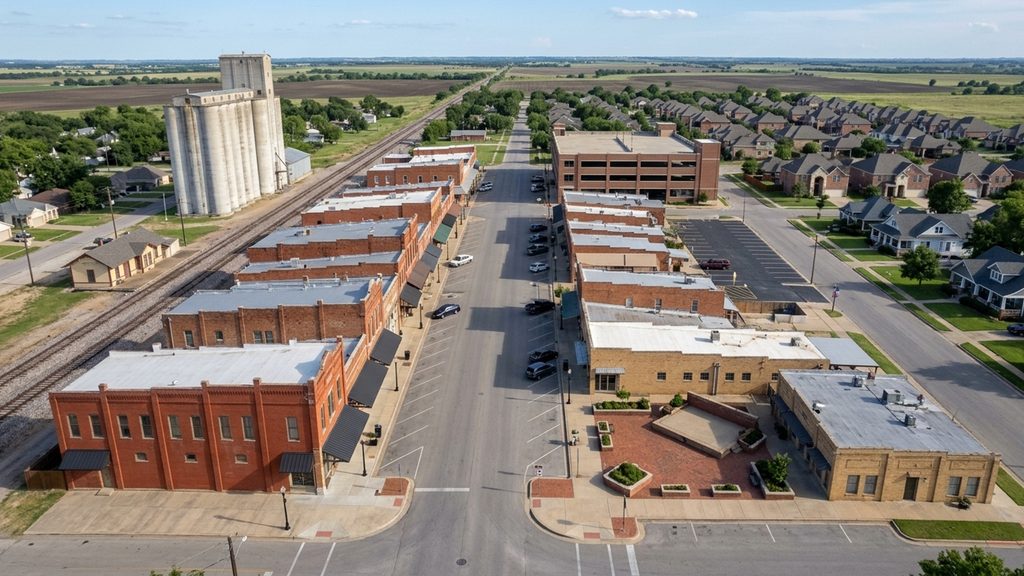
Historic downtown Frisco lines Main Street around the railroad depot site and the lots auctioned in 1902. It is known today as the Rail District, a name that honors the railroad that created the town. As the city’s original town center, it keeps the original street grid laid out beside the tracks.
Downtown has also been rebuilt for walking. After more than two years of construction, city leaders held a ribbon-cutting on October 13, 2026, for an $83 million project under the city’s 2018 Downtown Master Plan. The project widened Main Street’s sidewalks, redeveloped Elm Street and the 4th Street Plaza, added a performance stage on the plaza and built a five-story parking garage.
A short walk covers the main sights:
- Main Street: Walk the storefronts, where early-1900s buildings now hold boutiques and restaurants.
- 4th Street Plaza: Stop at the plaza at the center of the redevelopment.
- Grain elevators: Look for the towers from the cotton years, which still rise over downtown.
- Randy’s Steakhouse: Finish at the T.J. Campbell house rolled in from Lebanon.
Where to see Frisco history today
These are the first places you should visit to see Frisco’s past:
- Frisco Heritage Center and Museum: This history park at 6455 Page Street is run by the City of Frisco with the Heritage Association of Frisco. Beside the museum stand a steam locomotive and wooden caboose, the Frisco Railroad Depot, the Smith-Muse and Crozier-Covington-Sickles houses, a calaboose (jail), a blacksmith shop, a schoolhouse and a log cabin.
- Museum of the American Railroad: The museum shares space with the Frisco Discovery Center at 8004 N. Dallas Pkwy. Indoors is TrainTopia, a model-train exhibit. Outdoors, more than 70 pieces of steam, diesel, passenger and freight railroad equipment sit on 15 acres, with guided walking tours.
- Shawnee Trail marker: This Texas Historical Commission marker, erected in 1980, stands at 9700 Wade Blvd on the Collin College Preston Ridge campus. It is along the sidewalk to the parking lot in front of Heritage Hall.
- Other historical markers: The Heritage Association of Frisco has marked historic sites around the city. Ask at the Heritage Museum gift shop for a printed map of them to follow on a self-guided walking or driving tour.
Hours and ticket prices change, so confirm them with each site before you go.
Your advantage with Bale Real Estate Group
Buying or selling in Frisco requires more than just timing the market. The Bale Real Estate Group helps clients understand pricing, competition, and how to position a home to stand out from day one. If you are weighing a historic downtown property against a home in a newer neighborhood, Bale Real Estate Group can help you compare them.
Frequently asked questions
What railroad runs through Frisco today?
The St. Louis-San Francisco Railway was merged into the Burlington Northern Railroad Company on November 21, 1980. BNSF Railway, which later absorbed Burlington Northern, operates the core of the former Frisco system today as high-density mainlines.
Is anything left of the old town of Lebanon?
The clearest surviving piece is the T.J. Campbell house, now Randy’s Steakhouse. The Frisco Heritage Center grounds also preserve a historic building from Lebanon.
Are there rules for renovating a historic building in downtown Frisco?
Yes. Downtown’s Original Town Residential (OTR) and Original Town Commercial (OTC) zoning carries architectural design standards that limit exterior changes, materials and new construction. The Planning Division in the Development Services Department reviews projects, and some changes, such as larger building setbacks in OTC, need Planning & Zoning Commission approval. Owner-occupied OTR homes may qualify for a Historic Preservation Tax Incentive Program, so check with the Planning Division before planning changes to an older downtown building.
How do I get to the Shawnee Trail marker?
The marker stands at 9700 Wade Blvd on the Collin College Preston Ridge campus, along the sidewalk to the parking lot in front of Heritage Hall.
When did the Dallas North Tollway reach Frisco?
The tollway crossed SH 121 to Gaylord Parkway in Frisco in 2004 and extended to US 380 in September 2007.
Planning to sell? The Bale Real Estate Group helps sellers prepare, price, and market their homes.
Planning to buy? The Bale Real Estate Group helps buyers evaluate homes and complete their purchase.
Sources
City of Frisco: Original Town Residential (OTR) StandardsMissouri.
Heritage Association of Frisco: Heritage Center
City of Frisco: archived city document
SAH Archipedia: T.J. Campbell House
Texas Almanac: Frisco population chart
U.S. Census Bureau: 2018 city population estimates
Dallas Morning News: Frisco’s walkable downtown complete
City of Frisco: Frisco Heritage Center
Portal to Texas History: Museum of the American Railroad