What North Texas Home Buyers Should Know
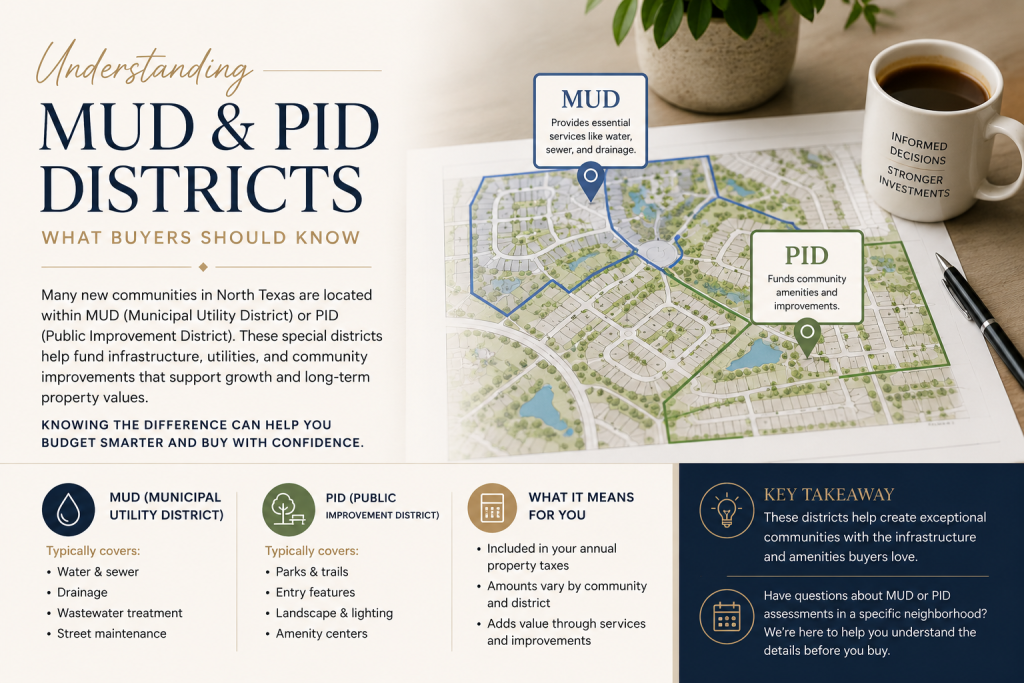
If you are purchasing a home in Frisco, Prosper, Celina, McKinney, Aubrey, Princeton, Melissa, or other rapidly growing North Texas communities, you may encounter homes located within a Municipal Utility District (MUD) or a Public Improvement District (PID).
These districts can provide funding for infrastructure and community improvements, but they may also affect your annual property tax obligations. Understanding how MUDs and PIDs work can help you make a more informed home-buying decision.
At Bale Real Estate Group, we believe buyers should understand all costs associated with homeownership before making a purchase.
What Is a MUD District?
A Municipal Utility District (MUD) is a special-purpose governmental entity created to finance and maintain infrastructure improvements for developing communities.
MUD districts often fund:
- Water systems
- Sewer systems
- Drainage systems
- Roads and utilities
- Infrastructure improvements needed for new residential development
The district typically issues bonds to pay for these improvements and repays the debt through property taxes collected from homeowners within the district.
What Is a PID District?
A Public Improvement District (PID) is a special assessment district created to finance community enhancements and public improvements.
PID assessments may help fund:
- Entry monuments
- Landscaping
- Community amenities
- Parks and trails
- Roads and streetscapes
- Community beautification projects
Unlike a MUD tax, a PID assessment is often listed separately on the property tax bill.
Why Do Developers Use MUDs and PIDs?
Large-scale master-planned communities often require significant upfront investment for infrastructure and amenities.
MUDs and PIDs allow developers to:
- Build communities sooner
- Install infrastructure before full build-out
- Fund parks and community amenities
- Reduce upfront development costs
Many of North Texas’ most popular master-planned communities utilize MUD or PID financing structures.
How Do MUD and PID Districts Affect Property Taxes?
Properties located within a MUD or PID district may have additional taxes or assessments beyond standard city, county, school district, and county property taxes.
Buyers should carefully review:
- Total property tax rate
- Annual PID assessments
- MUD tax obligations
- Future assessment schedules
- Estimated annual ownership costs
These costs can vary significantly from one community to another.
Are MUDs and PIDs Bad?
Not necessarily.
Many highly desirable communities throughout North Texas utilize MUDs or PIDs to fund infrastructure and amenities.
Potential benefits may include:
- Newer infrastructure
- Extensive community amenities
- Walking trails and parks
- Enhanced landscaping
- Community gathering spaces
- Attractive neighborhood entrances
The key is understanding the costs and benefits before purchasing.
Common Questions About MUD and PID Districts
Can a Home Be Located in Both a MUD and PID?
Yes. Some communities may have both MUD taxes and PID assessments.
Do MUD Taxes Last Forever?
Not necessarily. MUD taxes often decrease over time as bonds are repaid, although timelines vary by district.
Can PID Assessments Expire?
Many PID assessments have a defined repayment schedule. Buyers should verify the remaining term with the seller, title company, or local district.
Will a MUD or PID Affect Resale Value?
Generally, buyers focus on overall affordability, amenities, location, and community appeal. Understanding the district structure can help future buyers make informed decisions.
How Can Buyers Determine Whether a Property Is in a MUD or PID?
Before purchasing a home, buyers should:
- Review the Seller’s Disclosure Notice
- Review tax records
- Consult the title company
- Verify district information with the local municipality
- Ask their real estate agent for guidance
Understanding these costs before closing can help prevent surprises after move-in.
Related Buyer Resources
- Credit Score Requirements
https://balerealestategroup.com/credit-score-requirements/ - Down Payment Options
https://balerealestategroup.com/down-payment-options/ - Mortgage Pre-Approval
https://balerealestategroup.com/mortgage-pre-approval/ - Interest Rates Explained
https://balerealestategroup.com/interest-rates-explained/ - Texas Homestead Exemptions
https://balerealestategroup.com/texas-homestead-exemptions/ - Home Loan Process
https://balerealestategroup.com/home-loan-process/ - Buyer Closing Costs
https://balerealestategroup.com/buyer-closing-costs/ - Home Inspections
https://balerealestategroup.com/home-inspections/ - Offer Strategy
https://balerealestategroup.com/offer-strategy/ - Smart Buyer Strategy
https://balerealestategroup.com/smart-buyer-strategy/
Helpful External Resources
- Texas Commission on Environmental Quality (MUD Information)
https://www.tceq.texas.gov - Texas Municipal League
https://www.tml.org - Texas Department of Housing and Community Affairs
https://www.tdhca.texas.gov - Collin County Tax Office
https://www.collincountytx.gov/tax_assessor - Denton County Tax Office
https://www.dentoncounty.gov - Dallas County Tax Office
https://www.dallascounty.org
Why Work with Bale Real Estate Group?
Many buyers focus on purchase price while overlooking long-term ownership costs. Understanding MUD taxes, PID assessments, property taxes, HOA dues, insurance costs, and financing expenses can significantly impact affordability.
As a Top 1% North Texas real estate team, Bale Real Estate Group helps buyers evaluate the complete financial picture before making a purchase.
We provide guidance throughout the home-buying process so you can make informed decisions and avoid unexpected surprises.
Questions About a Specific Community?
If you are considering buying a home in Frisco, Prosper, Celina, McKinney, Melissa, Princeton, Aubrey, Plano, or another North Texas community, contact Bale Real Estate Group for assistance evaluating MUD taxes, PID assessments, property taxes, and overall ownership costs.
Clarity First. Pressure Never.